Exploring Key Quotes and Themes in Shakespeare’s Macbeth
This work has been verified by our teacher: 10.04.2026 at 11:45
Homework type: Essay
Added: 7.04.2026 at 5:49
Summary:
Discover key quotes and themes in Shakespeare’s Macbeth to deepen your understanding of ambition, power, and guilt for your English Literature essays.
The Role and Significance of Key Quotes in Shakespeare’s *Macbeth*
Shakespeare’s *Macbeth*, first performed in the early 1600s, stands as one of the most enduring tragedies in English literature. Set amid the turmoil and superstition of medieval Scotland, the play charts the rise and fall of Macbeth, a nobleman consumed by ambition and undone by the consequences of his own actions. At its heart, *Macbeth* explores universal themes: unchecked ambition, the corrupting allure of power, the burden of guilt, the influence of the supernatural, and the ever-present tension between appearance and reality. For students of English Literature in the United Kingdom, close analysis of Shakespeare’s language — especially his use of key quotations — is not merely an academic exercise, but a gateway to appreciating how big ideas and intricate characters come alive on the stage. This essay will examine a range of significant quotes from *Macbeth*, demonstrating how they encapsulate the play’s major themes, reveal the intricacies of character, and contribute to its dramatic tension and psychological depth.
---
Establishing Character and Conflict Through Early Quotes
Macbeth as Hero and the Seeds of Conflict
The earliest reports of Macbeth in Act 1, Scene 2 define him as a valiant and formidable warrior. A sergeant recounts how Macbeth’s blade “smok’d with bloody execution” as he carves his way through the enemy ranks. At first, this violent imagery establishes Macbeth as a loyal and heroic figure — showing the masculine ideals so revered in Jacobean society, where martial prowess translated directly to honour and status. However, the visceral imagery also quietly foreshadows the moral bloodshed and actual violence to come. Shakespeare’s choice to stress “bloody execution” ties inextricably to later events, hinting at Macbeth’s tendency towards violence and foreshadowing his eventual transformation from hero to murderer.The Witches: Ambiguity and Temptation
Early in the play, after meeting the three witches, Macbeth utters, “So foul and fair a day I have not seen” (Act 1, Scene 3). The phrase immediately echoes the witches’ paradoxical proclaiming, “Fair is foul, and foul is fair.” This connection subtly aligns Macbeth with the supernatural from the start, indicating that the line between good and evil, clarity and confusion, is already blurred. The ambiguous language — “foul and fair” — signals the moral murkiness that will define the play. In the cultural context of James I’s England, where witchcraft and the supernatural were subjects of both fear and fascination, this alignment with dark forces would have heightened the audience’s sense of foreboding and suspense.Duncan’s Trust and the Theme of Deception
King Duncan’s observation, “There’s no art to find the mind’s construction in the face” (Act 1, Scene 4), underlines one of the play’s central themes: appearance vs reality. Duncan laments his inability to read character from outward appearance, having just been betrayed by the previous Thane of Cawdor. His words are strikingly ironic, as he places his trust in Macbeth while the seeds of treachery are already taking root. This dramatic irony would not have been lost on Shakespeare’s audience, who would sense the tragic disconnect between Duncan’s perceptions and the audience’s privileged knowledge.Macbeth’s Hidden Desires
A crucial moment arrives when Macbeth, privately wrestling with what the witches have foretold, cries out, “Stars, hide your fires! Let not light see my black and deep desires” (Act 1, Scene 4). Here, imagery of darkness and concealment is paramount. Macbeth acknowledges he harbours illicit ambitions for the throne, and his use of astronomical imagery — imploring the stars themselves to "hide their fires" — dramatises his internal struggle to mask these thoughts from others and, perhaps, from himself. In Jacobean thinking, the association between darkness and evil would have been obvious. Shakespeare thus uses this quote to reveal Macbeth’s burgeoning inner conflict between his sense of duty and his overwhelming aspiration.---
Lady Macbeth and the Power of Manipulation
Challenging Gender Norms
Lady Macbeth’s famous reflection that her husband is “too full o’th’ milk of human kindness” (Act 1, Scene 5) provides early insight into both her ambition and her perception of gender. For Lady Macbeth, “kindness” is a weakness — a distinctly unmanly trait. Her willingness to deny traditional femininity and embrace the ruthlessness she feels Macbeth lacks challenges Jacobean gender expectations. This quote also establishes Lady Macbeth not simply as an accomplice but as the driving force behind Macbeth’s initial plunge into criminality, underlining her own intellect and resolve.The Serpent Beneath the Flower
In the same scene, Lady Macbeth instructs her husband to “Look like th’ innocent flower, but be the serpent under’t.” This is one of Shakespeare’s most memorable metaphors. The floral image suggests harmlessness and beauty, while the serpent — an explicit allusion to the Biblical tempter in the Garden of Eden — evokes danger, deception, and evil. The motif of appearance versus reality is more than a literary device; for the Macbeths, it becomes a survival strategy. Shakespeare lifts the metaphor beyond personal duplicity, inviting his audience to reflect on the true nature of ambition and the ease with which outward manners can mask inward corruption.Ambition, Conscience and Control
Macbeth’s own internal battle is artfully summed up in his soliloquy, “I have no spur to prick the sides of my intent, but only vaulting ambition, which o’erleaps itself and falls on th’ other.” He admits he lacks justification for regicide apart from sheer ambition, and the equestrian metaphor (“no spur to prick... vaulting ambition”) vividly captures ambition’s self-destructive potential. Lady Macbeth, however, quickly goads him on: “When you durst do it, then you were a man.” Her strategy is psychological as well as emotional; she equates masculinity with ruthlessness and bravery with transgressive action, thus manipulating Macbeth’s sense of identity. Through these exchanges, Shakespeare exposes the fragility of Macbeth’s character and the powerful, if ultimately ruinous, influence Lady Macbeth exerts.---
The Dark Night of the Soul – Symbolism and Psychological Turmoil
The Atmosphere of Darkness
Shakespeare envelops the critical moments of Duncan’s murder in darkness and an almost unnatural stillness. Macbeth, waiting for the signal from his wife, invokes: “Now o’er the one halfworld / Nature seems dead, and wicked dreams abuse / The curtain’d sleep” (Act 2, Scene 1). The atmosphere is thick with foreboding, where darkness is synonymous with evil, secrecy, and spiritual corruption. In the world of Jacobean theatre, such imagery would resonate deeply, couched in fears of night and the unknown.The Dagger Soliloquy
One of *Macbeth’s* most iconic passages comes as Macbeth hallucinates a bloodied dagger: “Is this a dagger which I see before me, / The handle toward my hand?” (Act 2, Scene 1). Here, Shakespeare deftly captures the protagonist’s tormented psychology. The apparition of the dagger embodies both fate (the weapon leading him to the inevitable act) and Macbeth’s own crumbling sanity. Macbeth’s blurring of reality and hallucination is emblematic of his deteriorating mental state and can be interpreted variously as supernatural intervention or overwhelming guilt.Banquo’s Moral Stand
Banquo, a character who hears the witches' predictions but resists them, prays to the “merciful powers” to shield him from evil thoughts. In contrast to Macbeth, Banquo symbolises integrity and caution; he does not indulge his ambitions at the expense of morality. This contrast between the two men underscores the play’s fundamental question about whether individuals are driven by fate or free will.The Murder and its Aftermath
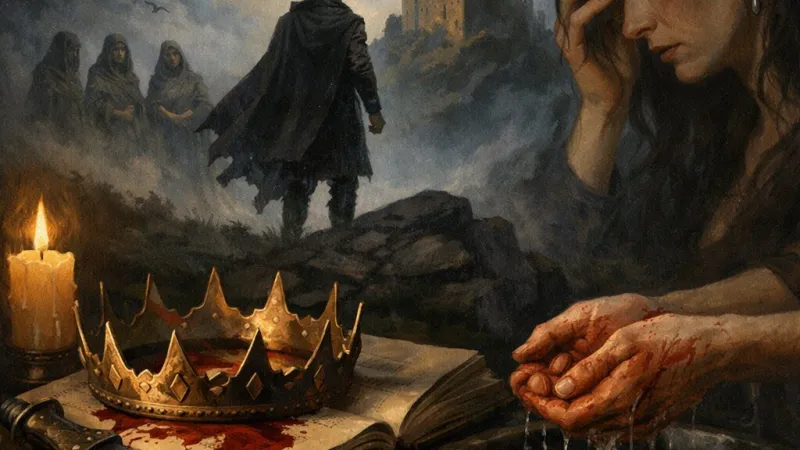
Of particular note is Shakespeare’s decision to keep Duncan’s murder offstage. Instead, the audience witnesses Macbeth and Lady Macbeth grappling with their guilt and fear. When Lady Macbeth insists, “A little water clears us of this deed“ (Act 2, Scene 2), she believes that physical washing will absolve moral stain. This is tragically naive; the motif of blood as a marker of guilt recurs throughout the play, especially as it becomes clear that neither Macbeth nor his wife can rid themselves of the psychological consequences.---
Thematic Development and Irony in Later Key Quotes
Growing Tyranny and Paranoia
Once crowned, Macbeth’s mindset shifts. “To be thus is nothing; but to be safely thus” (Act 3, Scene 1), he reflects, signalling that his unease has only grown. Paranoia now overshadows ambition, and Macbeth embarks on ever more desperate acts to secure his position. The insecurity inherent in seizing and holding power is laid bare — the King’s crown offers no peace.Banquo as Foil
Banquo’s suspicion is clear when he notes: “Thou hast it now: King, Cawdor, Glamis, all, as the weird women promised…” (Act 3, Scene 1). He is not deceived by Macbeth’s outward show of innocence, and his awareness lends tension and pathos to his subsequent murder. Banquo, representing a path not chosen, reminds the audience what Macbeth might have been, had he chosen differently.Lady Macbeth’s Downfall
By Act 5, Lady Macbeth’s earlier confidence is replaced by a haunted fragility. Her sleepwalking scene, in which she obsessively tries to wash imagined blood from her hands, is summarised in “Out, damned spot! Out, I say!” (Act 5, Scene 1). The physical and psychological become inseparable; unlike before, she can no longer distance herself from her guilt. Her demise is a poignant study of conscience and psychological collapse.---
Conclusion
In examining the most significant quotes from *Macbeth*, it is clear that Shakespeare weaves his themes, characters, and atmosphere together with masterful use of language. Whether through images of blood and darkness, the paradoxical pronouncements of the witches, or the intimate torments of guilt and ambition, each quotation encapsulates layers of meaning. The lines reflect the psychological depth of Macbeth and Lady Macbeth, the dangers of unchecked ambition, and the unresolvable tensions at the heart of the human experience. Key quotes thus serve not merely as memorable lines, but as essential keys to unlocking the haunting, enduring drama at the core of *Macbeth*—a play that continues to challenge, intrigue, and move audiences today.---
Tips for Analysing *Macbeth* Quotes
- Always consider the context of a quotation: who speaks, to whom, and under what circumstances. - Examine Shakespeare’s language: look for metaphor, imagery, or ambiguous phrasing. - Link the quote to the themes: ambition, guilt, fate, deception, and the supernatural. - Think about the character’s psychology, examining what the quotation reveals about their motives and feelings. - Reflect on dramatic effect: how does the quote shape the emotions or understanding of the audience? - Use short quotations as part of a wider argument, ensuring that analysis, not memorisation, is at the heart of your writing.In this way, you will approach your study of *Macbeth* not only as a set text but as a living, breathing work in which every line contributes to its power and lasting significance.
Rate:
Log in to rate the work.
Log in