How the Human Kidney Transports Substances and Maintains Body Balance
This work has been verified by our teacher: 16.04.2026 at 16:36
Homework type: Essay
Added: 15.04.2026 at 10:21
Summary:
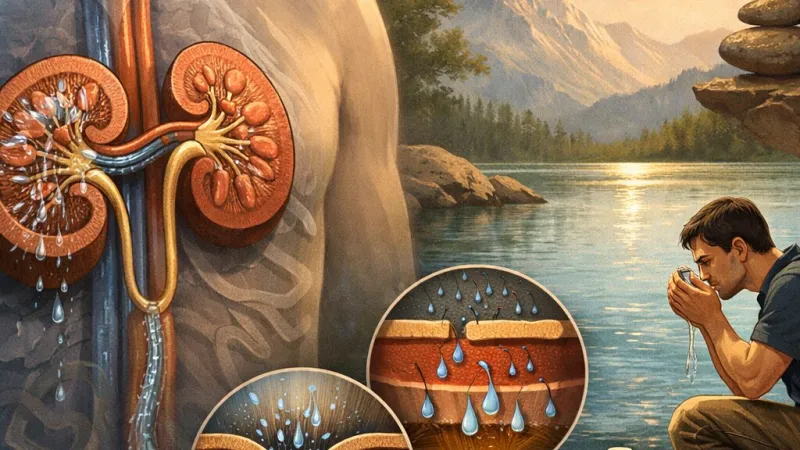
Explore how the human kidney transports substances and maintains body balance through filtration and reabsorption, essential for staying healthy and hydrated.
The Human Kidney: Transportation of Substances and the Maintenance of Internal Balance
The human body is a remarkable system, intricately designed to transport vital substances to every cell and, at the same time, protect itself by removing waste. At the heart of this internal network are the kidneys—two modest, bean-shaped organs which perform a task nothing short of miraculous: continuously purifying our blood, ensuring the chemical composition of our bodily fluids remains just right. This essay will examine the ways in which the kidney orchestrates the transportation of substances, its unique structural features, and its essential roles in homeostasis, filtration, selective reabsorption, and the fine-tuning of water and ion content within the body. By investigating these processes, we gain an appreciation for the kidney’s significance, not just as a filter, but as a dynamic, regulatory organ crucial to our survival.---
Anatomy and Structure of the Human Kidney
To understand the kidney’s function, one must first grasp its design. Located on either side of the spine, just beneath the rib cage, each kidney is no larger than a clenched fist but receives a disproportionately large share of the body's blood supply—about 20% of all blood at any given moment. This is not by chance, but by necessity: the kidneys must filter the blood exhaustively to sustain health.Internally, each kidney is divided into an outer cortex and an inner medulla, two regions with distinct roles. The cortex houses the initial sections of the functional units, while the medulla is home to structures that concentrate and carry away urine. But it is the nephron, of which around one million exist in each kidney, that deserves special mention. These microscopic units are the true engines of kidney function, each consisting of a glomerulus (a tangle of capillaries) ensconced within a cup-shaped Bowman’s capsule, followed by a long, convoluted tubule.
Bringing blood to this intricate filter is the renal artery; taking filtered blood away is the renal vein. Within each nephron, the glomerulus and associated capillary beds ensure that every drop of blood is presented to the filtration machinery. This intimate anatomical arrangement is fundamental—it allows for substances to move rapidly between blood and the nephron, so that filtration and reabsorption can occur efficiently and with astonishing precision.
---
The Process of Filtration in the Kidney
Filtration is the first critical step in kidney function, akin in some ways to passing dirty water through a sieve—though the kidney’s ‘sieve’ is astonishingly discerning. Blood, under high pressure, enters the glomerulus where the walls of its capillaries act as a selective barrier. Here, water and small dissolved substances—such as glucose, amino acids, urea, and mineral ions—are forced out of the blood and into Bowman’s capsule, forming what is known as the glomerular filtrate. Importantly, larger components such as blood cells and most proteins are too big to pass through and remain in the circulatory system.This process is especially important for eliminating urea, a toxic by-product of protein metabolism. Without the efficiency of this glomerular sieve, urea and other wastes would spiral to dangerous levels; indeed, the dire symptoms of kidney failure—highlighted by British medical classics such as Sir Arthur Conan Doyle’s “The Casebook of Sherlock Holmes: The Adventure of the Dying Detective”—often begin with an accumulation of uremic toxins.
The filtrate that emerges is essentially blood plasma minus the larger molecules and cells—a clear liquid ready for further processing. If left intact, however, far too much water and many valuable substances would be lost. Thus, the next phase—selective reabsorption—takes on vital importance.
---
Selective Reabsorption: Mechanisms and Regulation
If the kidney were simply a filter, its function would be wastefully inefficient. Instead, it is armed with the remarkable ability to reclaim what is needed. Selective reabsorption takes place as the filtrate journeys along the winding tubule of the nephron, predominantly in the proximal convoluted tubule.Glucose, for instance, is a precious commodity—each molecule reabsorbed with clinical precision, none left in a healthy individual’s urine. This is essential, as glucose is fundamental for cellular energy. Similarly, amino acids, the building blocks of proteins, are almost entirely reabsorbed for bodily growth and repair.
Mineral ions (such as sodium and potassium), are managed with care, as they influence nerve impulses, muscle contraction, and overall fluid balance within the body. The method of transport is tailored to the substance: small molecules move by diffusion, while certain ions and all glucose are reclaimed via active transport—a process powered by energy within the nephron’s cells. Water, conversely, follows these soluble substances through osmosis, moving towards regions where ion concentration is higher.
What is particularly ingenious is the adaptability of this system. When a person is dehydrated, for example, the kidney changes the extent to which it allows water to be reabsorbed, thereby conserving precious fluid. Similarly, dietary intake, hormonal signals, and the body's physiological state influence how much of each mineral ion is retained or excreted, demonstrating the dynamic regulatory capacity of the kidney.
---
Regulation of Water and Ion Content: Achieving Homeostasis
Homeostasis—the ability of the body to maintain a stable internal environment—relies heavily on the kidney’s powers of regulation. Fluctuations in water or salt levels can have immediate effects, making the role of the kidney all the more crucial. If, for instance, too much water is lost through sweating on a hot afternoon playing football, the kidneys respond by producing smaller, more concentrated quantities of urine. Conversely, after drinking several bottles of water, the kidneys increase urinary output and reduce its concentration, thereby preventing dangerous water overload.A central player in this feedback loop is the antidiuretic hormone (ADH), which acts as a signal prompting the kidneys' collecting ducts to reabsorb more water when necessary. Though details of hormonal regulation go beyond the GCSE syllabus, the presence of this system underlines just how responsive and adaptable the kidney must be.
Everyday circumstances bear witness to these mechanisms. Consider someone indulging in salty foods like crisps: the elevated salt load must be compensated by increased ion excretion, or risks upsetting the careful electrical balance required by the nervous and muscular systems. Loss of such balance is not trivial—it can disrupt heart rhythm and consciousness itself. Through continual adjustment, the kidneys thus shield us from potentially grave consequences.
---
Urine Production and Excretion
Having filtered the blood and reclaimed necessities, the kidney’s final act is urine formation—a fluid waste containing urea, excess mineral ions, and surplus water. The appearance and amount of urine offer clues to internal conditions. After a long run on a brisk London morning, one might notice urine becomes dark and concentrated, a mark of water conservation. On the other hand, after drinking plenty of fluid, urine is pale and more copious, reflecting the body’s excess.Urine collects in the bladder, a storage organ whose walls are richly supplied with nerves. Only when a person decides—within the limitations of social appropriateness and opportunity—does the bladder’s sphincter relax, and urine is allowed to exit the body via the urethra. This coupling of automatic and voluntary control speaks to the elegance of the excretion system.
Continuous urine production is crucial: it prevents accumulation of toxins and helps balance fluids and salts regardless of diet, weather, or lifestyle. Without it, waste products, such as urea, would quickly reach life-threatening levels.
---
The Kidney in Homeostasis and Human Health
Homeostasis encompasses the perpetual balancing act performed by our internal organs, and the kidneys are central to this act. Without their moderating influence, not only would waste and fluids spiral out of control, but the electrical and chemical workings of cells would falter. This is illustrated in George Orwell’s “The Road to Wigan Pier”, where references to poor sanitation hint at the dire outcomes for health where kidney function is compromised—symptoms such as oedema, mental confusion, and eventually, death.The repercussions of kidney malfunction ripple beyond the excretory system. Blood pressure, for instance, is intimately tied to fluid balance—a mismanaged kidney can set the stage for dangerous hypertension. Likewise, unchecked build-up or loss of sodium or potassium undermines the nerve signals governing every movement and thought.
To safeguard kidney health, a balanced intake of fluids and avoidance of excessive salt are advised—a message echoed by the NHS in public health campaigns. Routine health checks, especially for those with risk factors such as diabetes or high blood pressure, are recommended to detect early kidney disease before symptoms arise.
---
Rate:
Log in to rate the work.
Log in