The Essential Role of Chemistry in Everyday Life and Industry
This work has been verified by our teacher: 24.04.2026 at 15:15
Homework type: Essay
Added: 23.04.2026 at 5:58
Summary:
Explore the essential role of chemistry in everyday life and industry, learning key concepts like hydrocarbons, crude oil distillation, and chemical reactions.
Science – Chemistry: The Cornerstone of Modern Life
To many, chemistry evokes memories of acrid scents in the school laboratory, fizzing test tubes, or awkward attempts to balance equations. Yet these are mere glimpses of a discipline at the very heart of our understanding of nature. Fundamentally, chemistry is the scientific study of matter—its composition, structure, and the dynamic changes it undergoes. In British education, chemistry forms a crucial pillar of the science curriculum, providing students with not only essential theoretical concepts but also real-world relevance, from the air we breathe to the fuels that drive our buses and trains.
This essay will explore the pervasive influence of chemistry across several vital domains. We begin by delving into hydrocarbons and the industrial marvel that is fractional distillation of crude oil—a process as fundamental to British industry as the railway. The spotlight then turns to the composition of air and the techniques used to separate its components, followed by an examination of combustion, both efficient and hazardous. The enduring utility of limestone and its transformations will be unpacked, before turning to atomic structure, chemical reactions, and ultimately, the grand cycles of carbon that underpin climate and life. The interconnected nature of these topics reflects the holistic reach of chemistry in both the classroom and the wider world.
---
I. Hydrocarbons and the Fractional Distillation of Crude Oil
Hydrocarbons are among chemistry’s most prolific families, defined simply as organic molecules composed solely of hydrogen and carbon atoms. The most commonly encountered categories are the *alkanes* (saturated hydrocarbons with only single carbon-carbon bonds) and *alkenes* (unsaturated, containing at least one double bond). Though these distinctions may seem arcane, they underpin the vast diversity and utility of hydrocarbons. Their behaviour—whether burning cleanly in a Bunsen flame or acting as a foundation for new plastics—depends critically on the length and structure of their carbon chains.Consider crude oil, a mixture of hundreds of different hydrocarbons with chain lengths ranging from tiny methane (CH₄) to vast, tar-like molecules. These varying molecular sizes grant crude oil a range of physical properties. Short-chain hydrocarbons, like those found in bottled gas for home heating, are volatile and highly flammable, whereas long-chained fractions are more viscous, less volatile, and burn less readily—qualities exploited in the production of road surfaces (bitumen) and jet fuels.
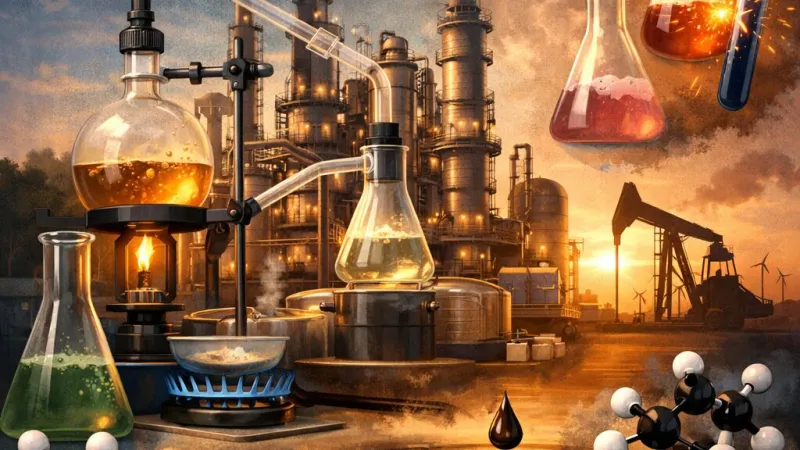
The fractional distillation of crude oil is a triumph of industrial chemistry. In this process, crude oil is first vaporised in a furnace and then introduced into a tall distillation column. Because different hydrocarbons condense at different temperatures (which increase from the top of the tower downward), the vapours separate as they ascend—lighter fractions like refinery gases condense near the top, while heavier fractions like diesel and bitumen settle lower down. Each resulting ‘fraction’ serves a distinct purpose: *petrol* for cars, *kerosene* for aircraft, *diesel* for lorries, and heavier oils for shipping or making lubricants. The process embodies both engineering ingenuity and chemical knowledge, enabling the UK’s energy and transport sectors to function efficiently.
Beyond fuelling vehicles, fractional distillation provides essential feedstocks for the petrochemical industry, whose products—plastics, synthetic fibres, detergents—are woven throughout modern British life. Balancing the need for these materials with their environmental impact is an ongoing societal challenge, highlighting the responsibility that comes with chemical insight.
---
II. Air Composition and Fractional Distillation of Air
Air may appear deceptively simple, yet its composition reveals a delicately balanced mixture crucial for life. The largest share—some 78%—is nitrogen, an inert gas vital for plant growth but otherwise non-reactive. Oxygen, comprising about 21%, sustains respiration and combustion alike. The rest consists mainly of argon (less than 1%), carbon dioxide, water vapour, and minuscule traces of noble gases.Industrial processes often require gases in a purer form than the atmosphere supplies. To obtain pure oxygen or nitrogen, air is first cooled to around -200°C, rendering it a liquid. Fractional distillation then separates the components by their boiling points; nitrogen boils at -196°C and so vaporises first, leaving oxygen behind. The pure gases are collected for use—oxygen in hospitals and welding; nitrogen as a protective blanket during chemical manufacturing.
While fractional distillation of air and crude oil both rely on differences in boiling point, their scales and purposes differ. In both contexts, however, successful separation rests upon an understanding of intermolecular forces and phase changes—key topics in the UK’s A-level chemistry syllabi.
---
III. Chemical Reactions: Fuels, Combustion, and Hazards
Combustion, the process of burning fuels, is something we rely on daily, from the gas flames of a cooker to the engines powering public transport. At its heart, combustion is a chemical reaction where a fuel combines with oxygen to release energy, typically in the form of heat and light. With hydrocarbons as fuels—methane or petrol, for instance—the products of complete combustion are carbon dioxide and water.Complete combustion is only achieved when there is enough oxygen supply. In a well-ventilated classroom Bunsen burner, this is easy to demonstrate: the flame burns non-luminous and hot, with negligible smoke produced. Contrast this with incomplete combustion—a scenario familiar to many Britons in poorly ventilated or faulty boilers, where insufficient oxygen leads to the formation of toxic carbon monoxide and sooty particulates. These by-products pose serious risks: carbon monoxide poisoning is silent but deadly, while soot contributes to respiratory illnesses and urban air pollution.
The balanced chemical equation for methane’s combustion can be written as: \[ \mathrm{CH}_4\ +\ 2\mathrm{O}_2\ \rightarrow\ \mathrm{CO}_2\ +\ 2\mathrm{H}_2\mathrm{O} \] Balancing such equations is not a mere classroom exercise; it reflects the deeper principle that atoms are neither created nor destroyed, merely rearranged—a law underpinning both chemistry and physics.
---
IV. Limestone: Composition, Decomposition, and Practical Uses
The chalk cliffs of Dover and the rugged Peak District hills bear testament to the prevalence of limestone (primarily calcium carbonate, CaCO₃) throughout the UK’s landscape. Chemically, this rock is both benign and versatile, making it the backbone—literally and figuratively—of the country’s infrastructure.Upon heating in a kiln (at about 900°C), limestone undergoes thermal decomposition, breaking down into quicklime (calcium oxide, CaO) and carbon dioxide gas: \[ \mathrm{CaCO}_3\ (\text{solid})\ \rightarrow\ \mathrm{CaO}\ (\text{solid})\ +\ \mathrm{CO}_2\ (\text{gas}) \] Quicklime, though highly reactive, is invaluable in the construction industry for making cement and mortar. When water is added to quicklime, it transforms into slaked lime (calcium hydroxide, Ca(OH)₂), used to neutralise acidic soils and treat drinking water. These applications are part of everyday British life—every time a road is repaired, or a new building arises, chemistry’s invisible hand is at work.
Moreover, limestone and its derivatives are employed in flue gas desulphurisation at power stations, reducing sulphur dioxide emission and thus the problem of acid rain—a notable concern in the UK during the twentieth century.
---
V. Atomic Structure and Types of Chemical Reactions
The entire edifice of chemistry stands on the understanding of atoms: the building blocks of matter. Each atom contains a *nucleus* of positively charged *protons* and neutral *neutrons*, surrounded by negatively charged *electrons* in energy levels or shells. The atomic number—proton count—defines the element (for instance, carbon has six protons). Variations in neutron number produce isotopes; for example, carbon-12 and carbon-14, the latter being essential in archaeological dating.Atomic structure dictates how atoms bond, combine to form elements (which contain only one type of atom) or compounds (combinations of different atoms), and how they behave during chemical reactions. In all reactions, the law of conservation of mass holds: the total mass of the reactants equals that of the products, as seen in both manufacturing and laboratory practicals.
Chemical reactions encountered at GCSE and A-level include thermal decomposition (as with limestone) and precipitation reactions, where mixing solutions produces an insoluble solid—like adding sodium sulfate to barium chloride to yield barium sulfate, a conspicuous white precipitate used in X-ray imaging.
Visible signs—colour changes, fizzing, precipitate formation or gas evolution—help chemists identify reaction types, making practical work a vital part of the UK science curriculum.
---
VI. The Carbon Cycle and Chemical Compounds
Further illustrating chemistry’s reach is the carbon cycle, a planetary process fundamental to life and industry. Through photosynthesis, plants absorb carbon dioxide from the atmosphere, incorporating it into carbohydrates that become, eventually, part of animal structure, fossil fuels, or atmospheric gases once more.Over millions of years, decaying matter is compressed into coal, oil, and natural gas. When we extract and burn these fossil fuels, we return ancient carbon to the air as carbon dioxide, contributing to the *greenhouse effect* and global climate change. Mastery of chemical formulae—which elegantly describe the atoms in each molecule—is critical in understanding and tackling these challenges.
Understanding carbon’s role, from chemical bonds in molecules to cycles spanning eons, is increasingly vital for developing green technology, whether it be carbon capture, low-carbon cement, or clean fuels.
---
Conclusion
Chemistry is not simply a subject to be endured until GCSE or A-level exams are over; it is a lens through which humanity understands and manipulates matter for progress. From the distillation towers of refineries and the quiet hum of a city bus engine, to the healing air of a hospital and the very rock on which towns are built, the principles of chemistry are ever-present. These topics—hydrocarbons and their separation, air’s life-essential components, the processes of combustion, the many uses of limestone, atomic theory, and the global carbon cycle—are linked by their impact on both our daily lives and the planet’s health.In confronting climate change, building sustainable cities, and developing new materials, chemistry remains at the forefront. For students in the United Kingdom, its study lays a foundation not just for academic achievement, but for meaningful engagement with the scientific, industrial, and environmental challenges of the coming century. To ignore chemistry is, quite simply, to overlook the mechanisms by which nature—and modern society—unfolds.
Rate:
Log in to rate the work.
Log in