An In-Depth Essay on Reproduction and Cloning in Biology for Secondary School
This work has been verified by our teacher: 1.05.2026 at 15:35
Homework type: Essay
Added: 29.04.2026 at 5:36
Summary:
Explore reproduction and cloning in biology with this detailed essay designed for UK secondary students to understand genetics, inheritance, and cloning methods.
Understanding Reproduction and Cloning in Biology 1b
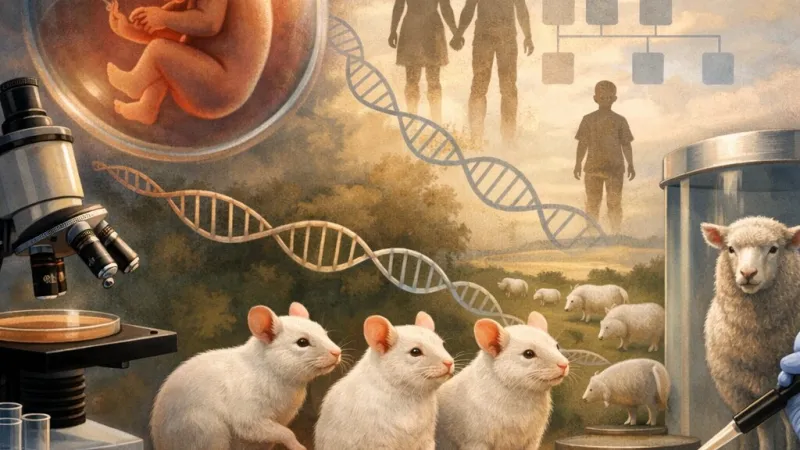
Reproduction lies at the very heart of biology, underpinning the perpetuation of all living things. Whether in the graceful migration of swallows, the blooming of bluebells in an English wood, or the hum of bees across a hedgerow, the passing on of life from one generation to the next is both constant and varied. At its core, reproduction is the process through which organisms create offspring—ensuring the survival of their species and the inheritance of their distinct traits. Contemporary biology, as taught in UK schools, delves deeply into how such inheritance is encoded at the molecular level through genes, chromosomes, and the extraordinary molecule known as DNA. Through understanding reproduction and the manipulation of genetic information, from traditional breeding to cutting-edge cloning and genetic engineering, we gain insight not only into how life continues but also how it can be shaped by human hands. This essay examines the contrasting processes of sexual and asexual reproduction, explores both natural and artificial cloning in plants and animals, and considers the intricate relationship between genetic variation, continuity, and human intervention.
---
Genetic Foundations of Reproduction
At the cellular level, life’s continuity depends upon the transmission of genetic information. DNA (deoxyribonucleic acid), present within the cell nucleus, serves as the blueprint for building each organism. Shaped in the iconic double helix described by Watson and Crick at the University of Cambridge, DNA consists of sequences of four bases which, in unique arrangements, encode genes—the fundamental units of heredity. These genes carry instructions for making proteins, which in turn dictate everything from eye colour to blood type.Chromosomes serve as the structurally organised carriers of these genes. In humans, for example, there are twenty-three pairs of chromosomes in each cell; in fruit flies (Drosophila melanogaster), there are only four pairs. The number of chromosomes and genes varies widely across the living world, yet the essential mechanism—passing a genetic legacy from one generation to another—remains consistent. Critically, the process of reproduction reshuffles and transmits this DNA, producing either genetic uniformity (as in asexual reproduction) or diversity (as in sexual reproduction). Such variation is a key driver of evolution; without it, species would struggle to adapt to ever-changing environments.
---
Sexual Reproduction
Sexual reproduction is a time-honoured process shared by most animals and flowering plants in the UK, from foxes in the woods to daffodils in spring gardens. The defining feature is the fusion of two specialised reproductive cells called gametes. In animals, these are typically sperm and eggs; in plants, pollen grains and ovules fulfil similar roles. Each gamete carries only half the full complement of genetic material (haploid), allowing for the restoration of the full set (diploid) upon fertilisation and the formation of a zygote.This mixing and matching of chromosomes from both parents injects remarkable diversity into the population. For instance, through the process of meiosis—which generates gametes—the distribution of genetic material is shuffled, introducing further variation through mechanisms like crossing over (where chromosome segments are swapped) and independent assortment (random separation of chromosome pairs). These processes underpin the genetic uniqueness of siblings, apart from identical twins, and fuel the evolutionary advantage of sexual reproduction, particularly in dynamic environments.
In British classrooms, examples routinely studied include the life cycles of frogs in local ponds and the reproduction of common garden plants such as peas (as in Gregor Mendel’s famous experiments). These examples help demonstrate how sexual reproduction fosters variation, enabling natural selection to act—a theme explored in Darwin’s seminal work, “On the Origin of Species,” much of which was inspired by observations in the English countryside.
---
Asexual Reproduction
In contrast, asexual reproduction produces offspring genetically identical to the parent, bypassing the need for gametes entirely. In the greenhouses and gardens across the UK, one often witnesses this form of propagation: potatoes sprouting from tubers or daffodils multiplying through bulbs. Side branches or runners—such as those seen in strawberry plants—can detach and take root, giving rise to new plants that are genetic replicas of the original.The advantage of asexual reproduction lies in its speed and simplicity. Where conditions are stable and well-suited, a single parent can rapidly colonise an area—think of how ground elder or Japanese knotweed can overrun a neglected allotment. In animals, asexual reproduction is far less common but can occur in certain species like starfish, which may regenerate entire bodies from fragments, and in some freshwater organisms such as hydra via budding.
However, a significant drawback is the lack of genetic diversity. Without new gene combinations, a population is less able to adapt to sudden changes—be it a particularly harsh winter or the outbreak of a new pest or disease. As a result, while asexual reproduction is very effective under predictable conditions, it carries inherent risks in an unpredictable world.
---
Cloning: Natural and Artificial Approaches
Cloning, technically a form of asexual reproduction, has captured both scientific and public imagination—none more so than when Dolly the sheep, cloned in 1996 at the Roslin Institute in Edinburgh, made headlines worldwide. Cloning describes the process of producing genetically identical organisms, but it takes several forms.Plant Cloning
Cuttings remain a mainstay in both amateur gardening and commercial horticulture in the UK. The technique is simple: a piece of stem or leaf is snipped from a healthy plant, its lower leaves are removed, and it is inserted into damp soil—sometimes with a dusting of rooting powder to encourage growth. Holly, geraniums, and fuchsias are often propagated this way.A more modern technique is tissue culture or micropropagation. Here, small sections of plant tissue—often just a few cells—are placed on a sterile growth medium containing nutrients and plant hormones. This enables mass production of disease-free plants, allowing commercial growers to rapidly produce thousands of identical specimens year-round. However, this method demands precise laboratory skills and equipment, making it less accessible outside of professional contexts.
Animal Cloning
In animals, two main cloning methods have emerged. Embryo splitting involves dividing a developing embryo at an early stage, before it has differentiated. This technique is used in breeding valuable livestock such as cattle, where each resulting embryo can be implanted into a surrogate, leading to genetically identical calves.More advanced is somatic cell nuclear transfer, the technique used to create Dolly. In this process, the nucleus of an adult somatic cell (for example, from a sheep’s udder) is transferred into an egg cell from which the nucleus has been removed. This hybrid then divides and develops into a new organism, genetically identical to the original donor. The implications of such techniques are profound: not only for agriculture—where desirable traits can be quickly multiplied—but also for conservation attempts, such as preserving endangered British wildlife.
However, these possibilities bring ethical considerations. Cloning reduces genetic variety, potentially making populations vulnerable to disease. Moreover, animal welfare concerns and the spectre of human cloning ignite public and parliamentary debate, reflected in the Human Fertilisation and Embryology Act and related UK legislation.
---
Genetic Engineering and Gene Transfer
Whereas cloning faithfully copies an organism’s genome, genetic engineering goes further—permitting scientists to alter or transplant individual genes between species. With the advent of recombinant DNA technology, genes conferring useful properties (like pest resistance or increased yield) can be inserted into crop plants. For example, genetically modified (GM) crops have been engineered to withstand diseases or adverse weather—a controversial topic that has been extensively debated by British farmers and consumers alike.In medicine, genetic engineering has enabled the production of important compounds such as insulin. Through gene therapy, inherited disorders—like cystic fibrosis, tragically well-known within the UK—may one day be treated at their source. Yet, despite the promise of genetic engineering, the modification of living genomes raises social, ecological, and ethical questions that are still being debated in Parliament and across British society.
---
Summary and Conclusion
Reproduction and cloning encompass an array of biological processes crucial to life’s continuation. Sexual reproduction, with its elaborate genetic shuffling, ensures diversity and adaptability; asexual reproduction offers efficiency and stability but at the cost of uniformity. Cloning—in both its natural and scientific forms—has opened up new horizons, both for benefiting humanity and prompting serious civic discussion. Understanding these processes, and the genetic mechanisms that underpin them, is not merely an academic pursuit but one with real-world applications in agriculture, medicine, and conservation.As we manipulate genetic material with increasing skill, it is vital to balance the promise of biotechnology with careful ethical reflection. For UK students, engaging with these topics means applying critical thought as well as scientific understanding, preparing them to navigate dilemmas that will shape their own future and that of the living world.
---
Additional Tips for Students
- Remember to refer to diagrams showing fertilisation, meiosis, and cloning—these can greatly aid your explanations in exams. - Draw on familiar examples, such as common British plants and farm animals, to anchor your discussion. - Clearly compare different methods of reproduction—tables or bullet lists can help distinguish key differences. - Consider the ethical dimensions and reflect on them alongside the science for higher-level insight. - Use British case studies, like the cloning of Dolly the sheep or the commercial propagation of UK fruit varieties, to provide relevant context to your arguments.---
In mastering the topic of reproduction and cloning, you not only fulfil the requirements of Biology 1b but also gain essential knowledge to understand, and perhaps one day influence, the living world around you.
Rate:
Log in to rate the work.
Log in