Evolving Family Structures and Patterns in the UK Today
This work has been verified by our teacher: 4.05.2026 at 12:57
Homework type: Essay
Added: 1.05.2026 at 9:00
Summary:
Explore evolving family structures and patterns in the UK today to understand changing roles, divorce trends, and diverse household dynamics in modern British society.
Changing Family Patterns in the United Kingdom
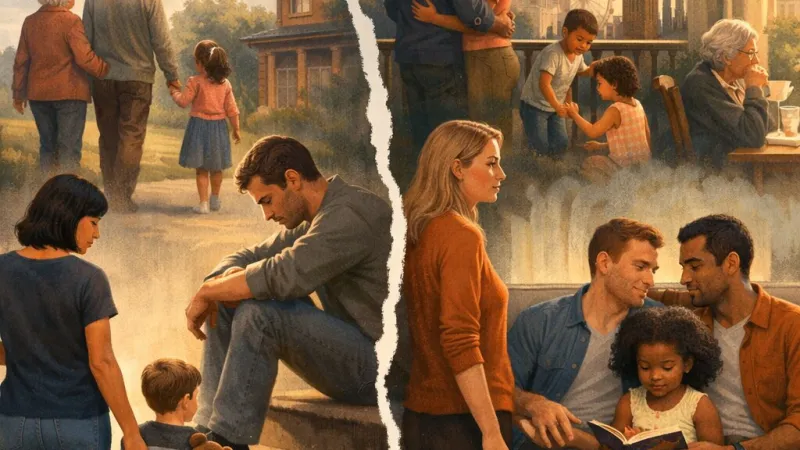
Family, in its many forms, has always occupied a central place in British society. The term 'family patterns' encompasses the structures, roles, relationships, and purposes within family units, and how these have altered through history. In the United Kingdom, the classic image of the nuclear family—composed of married mother and father with children—once reigned supreme, especially throughout the mid-twentieth century. However, the reality of domestic life today is far more complex, marked by diverse forms and evolving expectations.
Understanding how and why family patterns change is more than academic curiosity: these shifts bear significant consequences for social policy, gender relations, and the ways individuals define themselves. This essay explores the multifaceted transformation of families in the UK. We will examine the rising prevalence and significance of divorce, the growth of cohabitation and diverse partnerships, fluctuating household compositions, shifting childbearing and parenting roles, and the essential sociological theories that illuminate these changes.
---
I. Divorce and its Influence on Family Structure
Historical Trends and Legislative Shifts
For much of British history, divorce was a rare and stigmatised event, largely inaccessible to all but the wealthiest or most determined individuals. The passing of the Matrimonial Causes Act 1857 offered some middle-class couples the possibility of legal separation, but the real turning point arrived in the late twentieth century. The Divorce Reform Act 1969 marked a watershed, enabling couples to split if a marriage had suffered an 'irretrievable breakdown' rather than apportioning blame.Official statistics reflect this shift: in the early 1960s, divorce rates hovered below 3 per thousand married people annually. By the 1990s and 2000s, this figure had doubled. Legal reforms removed many practical and financial barriers—legal aid rendered court action affordable to the less wealthy, while gender neutrality in grounds for divorce meant women participated in these rising numbers in unprecedented ways.
Changing Attitudes and the Decline of Stigma
Alongside legal advances, cultural attitudes towards divorce softened. The image of divorced individuals as social pariahs steadily eroded during the seventies and eighties. Media depictions, from soap opera storylines to public figures navigating separation, brought new normality to what was once discussed only in hush-tones. The stigma's retreat enabled more people to seek fulfilment and autonomy, ending unhappy unions that may have continued in previous generations purely out of convention.The Effect of Secularisation
Secularisation, the weakening grip of religious authority, further unfastened marriage from the moorings of ‘til death do us part’. Census data and British Social Attitudes surveys reveal that lessening religious adherence parallels the rise of divorce and ‘alternative’ family forms. With fewer Britons attending church or viewing marriage as indissoluble, the moral imperative to stay together ‘for the children’ or in the eyes of God diminished.Social Factors and the Meaning of Divorce
The profile of those most likely to experience divorce has shifted too. Marrying young, remarrying, or having children from previous relationships all increase the likelihood. As the expectation for emotional satisfaction and equality grows, so does the willingness to end relationships that fail to deliver. Women's expanding economic participation grants financial independence, making marriage less necessary for survival and more of a chosen partnership.Yet, the meaning of divorce remains contested. New Right theorists—such as Charles Murray—argue high divorce rates signal a weakening of social fabric, destabilising children’s upbringing and undermining national morale. By contrast, feminists like Ann Oakley celebrate the escape from patriarchal control, reading divorce as a route to female empowerment. Postmodernists, notably Anthony Giddens, interpret these diverse family forms as evidence of greater individual freedom—where partnership is negotiated, not assumed. Functionalists such as Talcott Parsons, meanwhile, see evidence of the family’s enduring value in high remarriage rates: people may divorce, but they still seek familial bonds.
---
II. The Evolution of Partnership Patterns
Marriage: Decline and Transformation
There has been a marked decline in first-marriage rates since the 1970s, with many electing to marry later, if at all. For many, postponing marriage is a practical response to extended education, student debt, and insecure early careers—a reality well documented in sociological studies including Judith Stacey’s.Weddings themselves are transforming. Civil ceremonies now outnumber church weddings, mirroring the broader secular ethos, and challenging the notion of matrimony as a holy sacrament. The traditions and rituals around marriage, once rigidly defined, have become more flexible and responsive to the couple's identities.
The Rise of Cohabitation
Perhaps nowhere is the transformation of partnership more apparent than in the surge of cohabitation. Once associated with lower social classes or youthful experimentation, living together before or instead of marriage is now the norm across much of society. The Office for National Statistics reports that cohabiting couple families are the fastest-growing family type in the UK, with nearly 3.5 million such households in the early 2020s.For some, cohabitation functions as a ‘trial marriage’, allowing partners to test compatibility before legal commitment. For others, it is a conscious alternative, pursued for its flexibility or as a rejection of the institution of marriage. Economic necessity plays a part: high housing costs, unstable labour markets, and the prospect of expensive weddings incentivise sharing a roof without rings.
Same-Sex Partnerships and Diversity
The position of same-sex couples epitomises both progress and diversity in family life. Not long ago, homosexuality was criminalised in Britain, and social ostracism commonplace. Progressive legislation—beginning with the decriminalisation of homosexuality in 1967, through to the Civil Partnership Act 2004 and full marriage equality in 2014—has enabled same-sex couples to form officially recognised family units. Modern British life increasingly accepts and celebrates LGBT+ relationships, with charities such as Stonewall playing a pivotal role in advancing equal rights and social acceptance. The prominence of same-sex parent families further enlarges our conception of what constitutes family.Living Apart Together (LAT)
A relatively recent phenomenon is the LAT relationship: committed couples who choose to maintain separate households. This arrangement, sometimes due to career priorities, caring responsibilities, or previous commitments, underscores the move away from prescriptive models of partnership. It also invites us to reconsider what it means to be ‘family’ in a world of mobility and autonomy.---
III. Household Composition: Non-Traditional Forms
The Growth of One-Person Households
Demographic and cultural changes have led to a sharp increase in one-person households. As life expectancy rises, more elderly people—particularly widows—live alone, while divorce and separation have spawned new cohorts of solo adults. In 2022, over 8 million people in the UK lived alone, a number which has doubled since the 1970s. Unlike in previous generations, there is less stigma in choosing to reside alone, reflecting broader trends in individualism and self-sufficiency.Single-Parent Homes and Economic Implications
The post-divorce landscape has also seen a rise in single-parent families, most often headed by women. These families encounter unique economic and social challenges: despite reforms to child benefit, tax credits, and more recently, Universal Credit, lone parent households remain at greater risk of poverty and social marginalisation. Debates rage as to whether welfare policy supports or hinders independence, with New Right critics, such as the late Margaret Thatcher, warning of the supposed risks of creating a ‘dependency culture’.Multigenerational Households and Mobility
Conversely, some trends point towards renewed multigenerational households, especially among migrant communities (such as South Asian Britons) or in response to housing shortages and care needs. While less dominant than nuclear or solo arrangements, these family types remind us that changing patterns are not uniformly moving in one direction.---
IV. Parenthood and Childbearing Patterns
Birth Outside Marriage and Delayed Parenthood
Contemporary family life features a notable rise in children born outside marriage, now accounting for over 50% of births—a sharp reversal from the 1950s. Factors such as the declining stigma of single-parenthood, women’s career ambitions, and widespread use of contraception have all contributed. The average age of first-time mothers continues to climb, as many women invest in higher education before starting a family.Lone Parenting and Social Policy
Lone parenting is typically a result of relationship breakdown, death, or by choice. Feminist commentators point out that the continued feminisation of poverty reflects deep-seated gender inequalities, with women more likely to be primary carers and thus disadvantaged economically. Social policies aimed at supporting lone parents (from Sure Start to childcare subsidies) have had chequered success; some, influenced by New Right ideology, have sought to encourage marriage or restrict benefits, casting single mothers as a ‘problem’ to be solved.Redefining Parenting Roles
Traditional distinctions between ‘breadwinner’ and ‘homemaker’ are less clear-cut than ever. The rise of dual-income households, paternity leave (introduced in 2003), and flexible working arrangements signify a move towards more equitable sharing of parenting duties. Nonetheless, sociologists note persistent gender divides and the emergence of new forms of family tension as couples negotiate roles in the modern, post-industrial world.---
V. Theoretical Perspectives
A range of sociological approaches help to make sense of these changing family patterns:Functionalists like Parsons argue that, while family forms mutate, their functions—such as primary socialisation and emotional support—remain undiminished. The endurance of remarriage and the search for partnership uphold the family’s centrality, albeit in shifting guises.
New Right thinkers mourn the erosion of the nuclear family, blaming rising divorce and singleton households for everything from educational decline to ‘broken Britain’. They advocate policies that encourage marriage and the traditional breadwinner model.
Feminists, however, interpret these changes as steps towards gender justice, highlighting how divorce, cohabitation, and women’s employment free individuals from patriarchal constraints and allow for new, negotiated roles within—and outside—the home.
Postmodernist and ‘family diversity’ sociologists, such as Giddens and Beck, celebrate the ‘democratisation’ of intimate life. They emphasise agency, choice, and negotiation, arguing that there is no single blueprint for family in twenty-first century Britain.
Interactionists draw our focus to the lived experience and subjective meanings of family life—how individuals construct roles, identities, and relationships in day-to-day interaction, regardless of broader societal norms.
---
Conclusion
The landscape of family life in the United Kingdom has changed dramatically since the mid-twentieth century. Legal reforms, evolving social attitudes, economic pressures, and ideological debates have enabled new forms of partnership, household, and parenting to emerge. Sociologists have debated whether these changes reflect social decay, liberation, or simply the ongoing adaptation of an enduring institution to the modern age.Ultimately, the increasing plurality of family patterns mirrors broader changes in gender roles, individual autonomy, and cultural diversity. The future of the family will likely remain a subject of contestation and transformation. It is essential, both for policy makers and scholars, to understand these patterns—not only to appreciate the complexity of British society but to support families in all their forms as they negotiate the challenges of contemporary life.
Rate:
Log in to rate the work.
Log in