How the Cuban Revolution Shaped Cold War Dynamics in the Americas
This work has been verified by our teacher: 28.03.2026 at 17:40
Homework type: History essay
Added: 26.03.2026 at 15:24
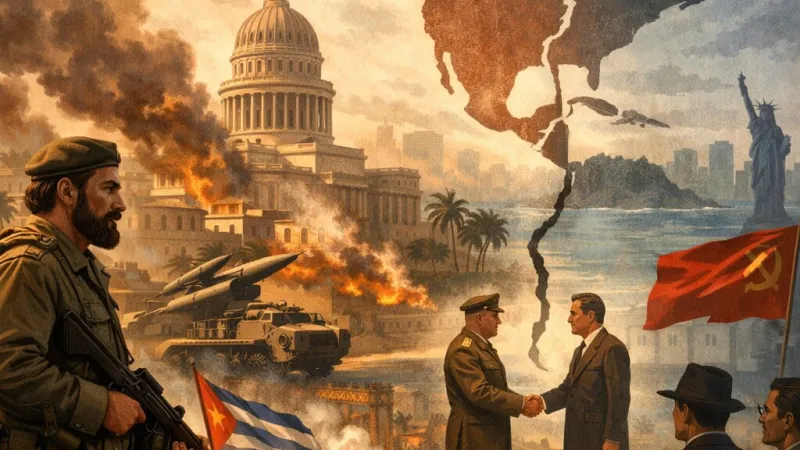
Summary:
Explore how the Cuban Revolution transformed Cold War dynamics in the Americas, shaping political tensions and alliances during a pivotal historical era.
The Cuban Revolution and the Cold War: A Watershed in Global Tensions
The second half of the twentieth century was defined by the Cold War, a period of protracted tension and rivalry between the United States and the Soviet Union. While armed conflict between the superpowers was largely averted, they fought vigorously for influence across the globe, shaping the destinies of many nations. One of the most significant flashpoints in this ideological struggle occurred not in Europe but in the Western Hemisphere: the Cuban Revolution. The success of Fidel Castro’s insurgency in 1959 marked a profound turning point, not only for Cuba itself but also for the balance of power in the Americas. This essay explores the causes and effects of the Cuban Revolution in the context of the Cold War, examining how it reshaped Cuba’s internal dynamics, provoked fierce reaction from the United States, drew in the Soviet Union, and altered the very character of East-West rivalry.
---
I. Antecedents to Revolution: Cuba Before 1959
Understanding Cuba’s pre-revolution landscape is key to appreciating why Fidel Castro’s movement gained such traction and why its consequences reverberated so far beyond the island’s shores.Cuba in the 1950s was nominally an independent republic, but in reality, its government was at the mercy of both local elites and foreign interests, particularly those of the United States. Under Fulgencio Batista—a military officer who seized power through a coup in 1952—the country was ruled as a de facto dictatorship. The Batista regime depended on heavy-handed repression to silence political opposition, with torture, detention, and extrajudicial killings becoming routine. Meanwhile, vast swathes of the country’s economy fell under American control: US companies owned much of Cuba’s fertile land, especially sugar plantations, and exerted dominance over banking, minerals, and the tourist trade. The famous Malecón of Havana, once a hub of cultural life, became lined with US-run casinos, nightclubs, and hotels, fostering an environment rife with corruption and organised crime—a fact famously depicted in Graham Greene’s "Our Man in Havana".
This economic dependency came at a cost for most Cubans. While the capital’s wealthy elite enjoyed the material trappings of modernity, the majority lived in rural poverty, lacking access to basic services like education and healthcare. In public consciousness, the government’s collusion with foreign interests and the prevalence of American gangsterism in Cuban towns fostered resentment and a feeling of stolen sovereignty. Batista’s position, while bolstered by American support due to his anti-communist stance, increasingly appeared untenable in the face of such widespread discontent.
---
II. The Rise of Castro and the Seeds of Revolution
It was amid these conditions that Fidel Castro, a young lawyer from a privileged background but with profound sympathy for Cuba’s poor, began organising resistance. Castro’s movement, later known as the 26th of July Movement—named after an earlier failed uprising—presented not just an opposition force but an ideological alternative. Drawing inspiration from nationalist heroes like José Martí, and increasingly influenced by Marxist thought, Castro’s guerrillas were able to gather popular support, particularly amongst rural communities who saw in him a champion of land reform and social equity.The tactics adopted—guerrilla warfare fought from the Sierra Maestra mountains—enabled Castro’s numerically inferior forces to harass and undermine Batista’s army. What differentiated this revolution from others was its ability to unite diverse factions: workers, students, peasants, and sections of the middle class, all united by the desire for radical change. By late 1958, Batista’s government was terminally weakened by military defeats, economic crisis, and growing international embarrassment. On New Year’s Day 1959, Batista fled Havana, leaving Castro’s forces to take control and herald a new era.
The new government’s early days were marked by a whirlwind of reforms: US-owned casinos and brothels were closed, land was redistributed, and the new administration pushed ambitious policies designed to eliminate the corruption of the previous era. What began as a nationalist, broadly progressive movement rapidly crystalised into an avowedly socialist project.
---
III. Revolution and Transformation: Cuba Under Castro
Nationalisation of key industries, most of which were owned by Americans, quickly followed, shocking the US and triggering an economic rupture. The Cuban government’s agrarian reform law, for instance, expropriated large estates and offered minimal compensation, often in Cuban pesos rather than US dollars. This radical shift unsettled both foreign investors and sections of Cuba’s business community, but for many ordinary Cubans—especially in the countryside—it brought tangible improvements: access to land, the promise of literacy, and free healthcare.Cuba’s transformation went beyond the economy. The government made education and healthcare central tenets of its policies. The National Literacy Campaign of 1961, mobilising students from urban areas to teach reading and writing in rural communities, is often cited as one of the most successful such efforts anywhere, resulting in near-universal literacy within a short period. The development of a free healthcare system, with doctors deployed to every corner of the island, became a source of national pride. Simultaneously, however, there was a cost: political opposition was swiftly marginalised, censorship was imposed, and many of Cuba’s former middle classes either went into exile or found themselves targeted as ‘counter-revolutionaries’.
For Cuban society, the revolution was thus both emancipating and restrictive—eradicating many of the ills of the Batista era, but also curtailing the civil liberties and pluralism that mark more open societies.
---
IV. Cuba as a Cold War Battleground: Alliance with the USSR
Isolated by its break with the US, Cuba desperately needed allies. The revolution's leftward tilt was met with growing hostility from Washington, which responded first by cutting sugar quotas—a devastating blow to Cuba’s chief export. The US imposed an economic embargo in 1960, discontinued diplomatic ties soon after, and began plotting ways to remove Castro from power. Facing such existential threats, Castro turned to the Soviet Union. For Nikita Khrushchev, then First Secretary of the Communist Party and keen to extend Moscow’s reach into the Western hemisphere, the opportunity was irresistible.The Soviet Union responded with generosity—sending oil, grain, technical experts, and crucially, military assistance. The image of a formidable ally just 90 miles off the coast of Florida was as provocative as it was symbolic. Cuba, once known as the ‘pearl of the Caribbean’, was now Lenin’s ‘beachhead’ in the Americas. The alliance upended the strategic balance: the US, accustomed to unchallenged dominance in the region, now faced the threat of communism on its own doorstep.
---
V. Escalation: The Bay of Pigs and Towards Nuclear Crisis
Tension rapidly escalated. The Bay of Pigs invasion in April 1961, a US-backed attempt by Cuban exiles to overthrow Castro, was a dramatic failure and a public humiliation for President Kennedy’s administration. The plan—conceived in secrecy by the CIA and drawing on the hopes of anti-Castro exiles—ended with almost all the invaders captured or killed. For Castro, it provided an opportunity to further entrench his regime and crack down on dissent, as well as to trumpet the revolution’s victory over imperialist aggression. For US-Soviet relations, it was a new nadir, foreshadowing the even graver Cuban Missile Crisis of 1962.The failed invasion only strengthened Castro’s reliance on the Soviet Union and justified Khrushchev’s decision the following year to secretly install nuclear missiles on the island—a move which brought the world the closest it has ever been to global nuclear catastrophe. The negotiations and eventual withdrawal of these missiles marked both the dangers of superpower rivalry and the crucial role played by smaller nations in influencing the course of the Cold War.
---
VI. Broader Implications and Legacies
The Cuban Revolution challenged the established order in the Americas. The success of an armed socialist movement in the US’s backyard gave hope to leftist movements across the region—from Nicaragua’s Sandinistas to guerrillas in Colombia and beyond—while simultaneously prompting harsher repression by US-backed regimes. The policy of ‘containment’ initiated by Truman and developed in documents like the British-American ‘special relationship’, was given new impetus. The Caribbean and Latin America became key battlegrounds in the fight for ideological dominance.Cuba’s unique position highlighted the interconnectedness of local and international struggles. For the superpowers, it tested resolve and risked genuine conflict; for Cubans themselves, it inaugurated decades of both achievement and hardship under a regime sometimes more focused on survival than on individual freedoms. The embargo, still in place in various forms, remains a legacy of this period, continuing to shape both Cuban society and US foreign policy.
---
Rate:
Log in to rate the work.
Log in