A Detailed Analysis of the 1955 UK General Election Campaign
This work has been verified by our teacher: 4.04.2026 at 18:54
Homework type: History essay
Added: 1.04.2026 at 5:53
Summary:
Explore how the 1955 UK General Election campaign shaped modern British politics through party strategies, media influence, and post-war social change.
How Was the 1955 General Election Fought?
The general election of 1955 stands as a significant moment in modern British political history. This essay aims to examine how the election was fought, exploring the interplay between political narratives, campaign strategies, and the emerging influence of media within the distinctive social and economic backdrop of post-war Britain. The period was marked by a transition from austerity towards increasing affluence, and this, coupled with developments in party leadership and shifting class identities, shaped both voter expectations and the methods by which parties sought their support. Focusing largely on the contest between the incumbent Conservative Party, freshly under Anthony Eden, and the Labour Party, newly led by Hugh Gaitskell, this essay will argue that the 1955 election reflected both continuity and change: established campaign traditions were reinforced, yet the employment of newer media and a more professional style of electioneering foreshadowed the nature of modern British politics.
---
I. Political Context and Party Positions
The political landscape of the early 1950s was characterised by an electorate growing weary of post-war hardship but conscious of the social advances initiated in the previous decade. The Conservatives had wrested power from Labour in 1951, with Winston Churchill offering a sense of wartime continuity and reassurance. By 1955, Churchill had retired, making way for Anthony Eden—a figure who exuded a polished, statesmanlike image seen by many as more in tune with contemporary aspirations.Opposing the Conservatives, the Labour Party had recently undergone a leadership change: Clement Attlee, the architect of much post-war reform, gave way to Hugh Gaitskell. Gaitskell’s leadership marked a new chapter; he was seen as part of a younger, modernising generation aiming to maintain Labour’s commitment to the welfare state while adopting a less dogmatic approach, particularly regarding nationalisation.
Central to the campaign were several pressing issues. Economic prosperity was chief among them: while much of the hardship of the immediate post-war years had eased, questions over inflation, housing shortages, and employment persisted. The end of food rationing in 1954 had generated a sense of relief, and the growth in consumer goods—televisions, washing machines, cars—began to reshape the desires of the electorate, especially within the expanding middle class.
Defence policy and the Cold War also featured prominently. The Conservatives championed a policy of nuclear deterrence and strong ties to NATO, capitalising on public anxiety over Soviet expansionism. Labour’s position appeared less clear, with the party divided over the hydrogen bomb—a split which the Conservatives were quick to exploit.
The battle lines were drawn in the party manifestos. The Conservative manifesto, “United for Peace and Progress,” promised stability, growth, and gradual improvement in living standards, eschewing radical change. Meanwhile, Labour’s “Challenge to Britain” continued to champion the NHS and social security, but also promoted modernisation and increased efficiency. While both offered visions of a hopeful future, the Conservatives emphasised continuity with the recent, modest growth, and Labour strove to rekindle enthusiasm for social reform while promising to avoid the return to drabness or sacrifice.
---
II. Campaign Strategies and Leadership Styles
Leadership and image played an especially critical role in the 1955 election. Anthony Eden, with his meticulous tailoring and patrician ease, was the very embodiment of the post-war establishment, offering reassurance in a rapidly changing world. His public appearances were carefully orchestrated, with an emphasis on projecting calm, shrewd competence—contrasting with the more austere, intellectual manner of Hugh Gaitskell, who, while respected, lacked Eden's flair for public relations.The Conservative campaign was, in many respects, cautious but calculated. Slogans such as “Don’t Let Labour Ruin It Again” resonated with voters who associated the early Attlee governments with rationing and controls. Eden’s team were adept at targeting ‘swing’ constituencies: they tailored local messages to areas still struggling with housing or employment, while trumpeting national economic stability where appropriate. The party machine, benefiting from business support, was well-funded and highly organised, allowing for widespread distribution of visually striking posters and pamphlets bearing Eden’s reassuring visage.
Labour, by contrast, laboured under the twin pressures of internal division—particularly over defence policy—and the need to re-energise a weary working-class base. Gaitskell sought to modernise Labour’s appeal without alienating its traditional supporters; to this end, the party adopted a more managerial tone, emphasising competence as much as idealism. Labour’s campaign leaned heavily on grassroots activism, with mass canvassing and party meetings in working men’s clubs, Methodist halls, and urban squares—a reminder of its deep ties to local communities.
Both major parties made extensive use of posters and pamphlets, often featuring simple, memorable slogans (“Conservative Freedom Works,” “Labour Gets Things Done”) and images designed to evoke security, prosperity, or social justice. The choice of words and visual cues demonstrated an increasing sophistication in political advertising.
Public speeches remained a key feature of the campaign, with Eden and Gaitskell both making set-piece addresses in major cities. Eden’s speeches, broadcast by radio and increasingly captured by newsreels, sought to convey unity and a steady hand, whereas Gaitskell’s more academic style aimed to convince the electorate of his party’s competence and responsibility.
---
III. Media Influence and Communication Methods
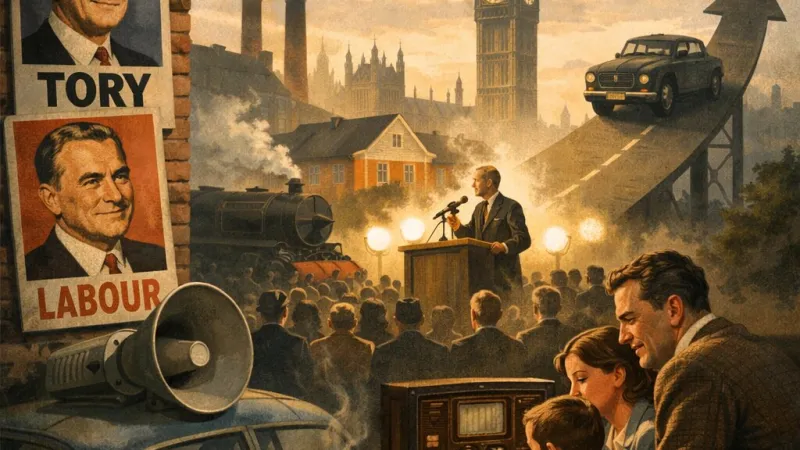
By 1955, the British media landscape was in a state of flux. Newspapers remained the most influential conveyors of information and opinion. Papers like The Times, The Daily Telegraph, and The Daily Express offered predominantly pro-Conservative coverage, while The Daily Mirror and The Tribune backed Labour. Editorial stances carried significant weight, with public endorsements from major papers viewed as valuable assets. Coverage could be partisan and, at times, shrill—satirical cartoons lampooned leaders, while commentaries on economic policy filled the broadsheets and the red-tops alike.However, the lasting legacy of the 1955 campaign may arguably be its tentative embrace of television. For the first time, party political broadcasts reached a significant slice of the electorate through the BBC. While television ownership was not yet universal—concentrated among more affluent, largely urban households—it offered party leaders the opportunity to project their personalities directly into people’s living rooms. Eden’s debonair appearance suited the small screen, while Gaitskell’s more reserved manner was less telegenic. The parties quickly learned that image mattered as never before, even though the technical and regulatory limits of the era kept TV’s influence in check compared to later decades.
Radio, meanwhile, remained crucial, especially in rural areas and among the elderly. National events, such as major speeches or debates, were broadcast widely on the BBC Home Service, ensuring that party messages could reach those outside print media’s usual reach. Equally significant were newsreels, which played in cinemas across the country: short films produced by British Pathé or Movietone presented campaign highlights in a brisk, visually engaging format, making politicians more recognisable and reinforcing key messages.
---
IV. Electoral Geography and Voting Patterns
Another lens by which to examine the 1955 campaign is through its electoral geography. Parties channelled major resources into marginal seats—the difference between electoral victory and defeat resting on a few thousand votes. The Conservatives, with superior funding, could afford targeted campaigns in key swing constituencies across the Midlands, the North, and outer London suburbs. Labour relied more on activist networks in its heartlands, but was less successful in recapturing the enthusiasm of 1945.Class, as ever, remained a decisive factor. Working-class voters in industrial regions were likely to remain loyal to Labour, but the growth in affluence, home ownership, and consumerism was blurring old lines. The Conservatives benefited from a growing identification of the ‘aspirational’ classes—clerical workers, small proprietors, and skilled manual workers—with their emphasis on prosperity and individual advancement. This shift was particularly marked in new, suburban districts, where the promise of “never having it so good” found receptive ears.
Regional variation was also marked: Labour dominated in the mining villages of the North-East and the manufacturing cities of Lancashire; the Tories held sway in the Home Counties, rural shires, and prosperous market towns. Yet the campaign was strategically nationwide, with messaging subtly tailored to local anxieties and hopes.
---
V. External Factors Impacting the Campaign
International and social undercurrents provided a further backdrop. Although the Suez Crisis lay just ahead, Cold War tensions were palpable, with the Soviet threat a constant drumbeat in political discourse. The Conservatives were able to paint Labour, divided on nuclear weapons and foreign policy, as less reliable custodians of national security. References to NATO, the Commonwealth, and Britain’s world role peppered campaign speeches, tapping into a lingering sense of imperial pride.At home, increasing living standards played to the Conservatives’ strength. The government pointed to rises in wages, employment, and the quantity of consumer goods as evidence of sound stewardship; Labour, by contrast, found it harder to mobilise discontent in this more optimistic climate. The question for voters was not one of revolutionary change, but rather the pace and direction of incremental improvement.
Social trends were also shifting. The post-war insistence on collective sacrifice was yielding to a growing celebration of personal and familial well-being: the desire for home ownership, holidays, and new electric gadgets. Women, many entering the polling booth with increased economic and domestic autonomy, became a key target for party messages centred on cost of living and household prosperity.
---
Conclusion
The 1955 general election was fought through a mix of established and innovative strategies, all shaped by Britain’s unique moment of social and economic transition. Party contest took the familiar shapes of leadership, policy, and geography, but also reflected a new era in political communication, as radio, television, and more sophisticated advertising techniques made their mark. The contrast in leadership styles—Eden’s smooth assurance versus Gaitskell’s earnest modernity—provided voters with genuine choice, though the mood of the country seemed to favour steadiness over experimentation. The Conservatives’ victory was built not simply on fear of Labour’s past or the promise of prosperity, but on their ability to articulate a credible vision for a nation eager to move beyond post-war gloom.In hindsight, the methods and culture of the 1955 campaign anticipated many developments of subsequent British elections—the rising importance of media image, the targeting of marginal seats, and the shift towards an electorate less obviously divided by class. As such, the 1955 election can be seen as a pivotal stage in the evolution of the modern party-political contest in Britain, marrying traditional party loyalties with the first stirrings of mediatized, personality-driven politics.
Rate:
Log in to rate the work.
Log in