Exploring Social Decay and Symbolism in The Great Gatsby Chapter 2
This work has been verified by our teacher: 20.04.2026 at 11:21
Homework type: History essay
Added: 17.04.2026 at 13:11
Summary:
Explore the social decay and symbolism in The Great Gatsby Chapter 2 to understand themes of class, morality, and the novel’s vivid setting in depth.
The Great Gatsby – Chapter 2: Setting, Symbolism and Social Decay
F. Scott Fitzgerald’s *The Great Gatsby* stands as one of the most enduring commentaries on the foibles and fissures of early twentieth-century society. Nowhere is this critique more precisely articulated than in the novel’s second chapter. Situated as a bridge between the gilded pretensions of the Eggs and the pulsating energy of New York, Chapter 2 thrusts readers into a liminal world—the “valley of ashes”—where dreams wither and the weight of social divisions is painfully present. In a British educational context, this chapter is of particular relevance for A Level and IB English Literature students because it foregrounds questions of class, morality, and identity, connecting American anxieties to conflicts that resonate within our own history and literature, from the industrial landscapes sketched by Charles Dickens to the biting class satires of Evelyn Waugh. Through its searing imagery, complex characterisation, and pregnant symbols, Chapter 2 challenges the shimmering illusions of the Jazz Age and lays bare the darkness at its heart.This essay examines how Fitzgerald constructs the valley of ashes as both a literal landscape and a powerful social allegory; scrutinises the novel’s key symbols and character portraits; and considers how narrative technique and atmosphere deepen the thematic exploration of illusion, decay, and longing. In doing so, it will connect the concerns of Fitzgerald’s world to broader questions of wealth, aspiration, and moral vision that remain troublingly contemporary.
---
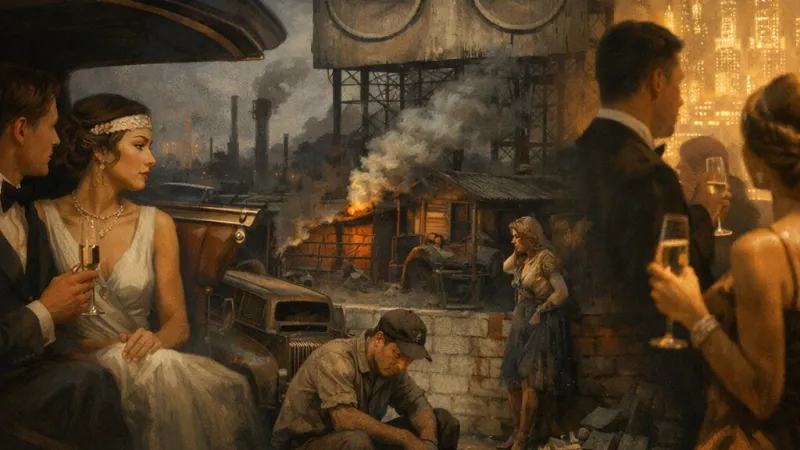
The Valley of Ashes: Setting as Social and Moral Allegory
Fitzgerald’s valley of ashes is no mere backdrop, but a poisoned wasteland that seeps into the consciousness of the novel. Its physical desolation—shrouded in grey dust, bordered by railways and abandoned industry—evokes the grim detritus of Britain’s own industrial revolution, calling to mind the polluted Thames of *Bleak House* or the smog-veiled streets of Coketown in *Hard Times*. Within *The Great Gatsby*, this space is explicitly transitional, “about half way between” the luxury of West Egg and the hedonism of Manhattan, yet, rather than connectivity, it epitomises all that is discarded in pursuit of modern, urban pleasures.The valley is described as “a fantastic farm where ashes grow like wheat into ridges and hills and grotesque gardens,” the oxymoron underlining a blighted parody of natural abundance. The recurring ashen imagery comes laden with symbolic import: ashes suggest destruction, failed renewal, and the bodily remains of fading hope. The chapter uses pathetic fallacy—coldness, lifelessness, and dust—to create a mood of entrapment and stasis, forecasting not only the personal tragedies to come but the moral suffocation lurking beneath social prosperity. The “small foul river” that “creeps” through the valley does not cleanse or give life—it further entrenches boundaries, reinforcing the impossibility of transformation for those, like George Wilson, mired within it.
Economically, the valley literalises the class divide: it is both a graveyard for the by-products of the wealthy’s excess and home to a forgotten working class, making visible the cost of opulence that is so often overlooked. For British readers attuned to national histories of class tension—from the miners’ strikes to current debates around social mobility—Fitzgerald’s imagery is deeply resonant, provoking empathy and unease in equal measure.
---
The Eyes of Doctor T.J. Eckleburg: Ghostly Witness to a Godless Age
Presiding over this wasteland are “the eyes of Doctor T.J. Eckleburg,” a faded billboard advertising a forgotten optician. The sign’s massive blue eyes, rimmed by yellow spectacles, exist in stark relief against the greyness that surrounds them. Stripped of a face or body, these eyes become almost supernatural, their impassive gaze lingering over both the landscape and its desperate inhabitants.The eyes’ symbolism is multifaceted. On one level, they evoke the decline of religious certainty. With institutional faith corroded by modernity and materialism, Fitzgerald’s America is watched over not by a benevolent deity, but by a hollow commercial emblem—much like Dickens deploys the law as a cold, unfeeling abstraction in *Bleak House*. George Wilson’s later invocation of the eyes as the eyes of God is laced with tragic irony, highlighting both his yearning for justice and the absence of moral guidance.
At a more worldly level, the eyes indict the society they stare upon: they are unblinking but inactive, recording but not intervening. This critique can be linked to the contemporary rise of “surveillance society”—resonant even in modern Britain—where we are constantly watched (by CCTV or social media) but still feel a moral vacuum at the heart of collective life. The fact that this symbol is an advertisement underscores Fitzgerald’s commentary on spiritual impoverishment and commodification: even vision itself is up for sale, and any hope of transcendence is lost beneath the deadening weight of consumer capitalism.
---
Tom Buchanan: Brutality Cloaked in Privilege
Tom Buchanan, introduced in the previous chapter as an emblem of old money, becomes in Chapter 2 even more menacing—the “cruel body” that dominates both scene and people. His arrival at the garage, laced with impatience and condescension, sets the tone: Tom is not content to merely possess wealth; he must exert it, stamping his authority upon all he meets.His interaction with George Wilson, whom he patronises and exploits, is blatantly imperial—reminiscent of aristocratic disdain chronicled by writers like Forster in *Howard’s End* or upper-class figures in Stella Gibbons’ *Cold Comfort Farm*. With Myrtle, Tom’s treatment is, if anything, more troubling: he enjoys her sexual availability and her social ambition, but is quick to violence when she challenges boundaries (as with the infamous blow that bloodies her nose). Whether buying her a puppy on a whim, or displaying her at a sordid party, Tom treats others as accessories, entitled to their bodies and dreams because of his inherited status.
Fitzgerald paints Tom not only as an individual brute, but as an avatar for an entire class whose dominance rests on inherited power and aggression. His disregard for the eyes of Doctor T.J. Eckleburg implies a belief in his own impunity—a chilling reminder of those in any society who act as if beyond judgment or consequence.
---
George Wilson: Spectre of the Voiceless Working Man
Against Tom’s force, George Wilson is portrayed as a spectre of exhaustion. His “ashen, anaemic” features blend seamlessly with his “unprosperous and bare” garage. Unlike Tom, whose violence and confidence fill the space, Wilson is quiet, tentative, and largely ignored—by his wife, by Tom, and by the city beyond. The narrative lingers on his hopefulness—his yearning that Tom might deliver a car sale, providing some hope for escape—but repeatedly shows that hope dashed.Fitzgerald’s depiction invites a degree of sympathy unusual for his more glamorous characters. The language used to describe Wilson’s environment is suffused with empathy, marking him as tragic, even before the events that plunge him into despair. His invisibility serves as a broader social critique: just as interwar Britain was grappling with the legacy of economic depression and the “Two Nations” question, so too does Fitzgerald reveal how the Jazz Age produces new forms of marginalisation. The scene in the garage is a microcosm of a society where the powerless are not just forgotten but structurally entrapped.
---
Myrtle Wilson: Yearning for a Life She Cannot Reach
Myrtle Wilson is one of the novel’s most tragically complex figures. Her physical energy and boldness mark her apart from Tom’s gossamer wife Daisy; in the stuffy gloom of her apartment, Myrtle is sensual, assertive, even haughty. Her attempts to mimic upper-class behaviour, from changing outfits to demanding attention, betray both her ambition and her insecurity.Unlike Tom, for whom privilege is effortless, Myrtle’s grasping is both performance and survival—a phenomenon not unknown to British class climbers documented by Arnold Bennett or in *The Forsyte Saga*. Her materialism, evident in the way she receives gifts and parades her purchases, is a double-edged sword: it mocks society’s shallow values, but also exposes the futility of her hopes. Myrtle’s insistence that she “married below her” and her airs with Catherine and the McKees show the fragility of her invented persona, hinting at the pain of social exclusion.
Fitzgerald, however, does not render Myrtle a simple opportunist. Instead, he makes her a portrait of thwarted longing, the “American Dream” warped by the boundaries that reality imposes. Her self-mythologising is doomed, yet it lays bare the ache for change that animates much of the novel.
---
Social Satire and the Minor Characters
At Myrtle and Tom’s flat, secondary characters—the McKees and Myrtle’s sister Catherine—accentuate the sense of falseness and absurdity. The McKees’ awkwardness, with Mr McKee’s vacuous talk of photography and Mrs McKee’s desperate social climbing, lampoons the shallowness of middle-class aspiration. Their interactions are all surface—fragmented, performative, self-deluding.Through the lens of these parties, Fitzgerald deftly captures the breakdown of genuine community—much as Virginia Woolf contemplates isolation amid crowded London streets in *Mrs Dalloway*. The social scene is rife with gossip, petty jealousy, and self-importance. Detached self-awareness is in short supply: characters act roles rather than risk authenticity, and the party’s eventual descent into violence and drunkenness is almost inevitable given the emotional poverty on show.
---
Narrative Perspective, Structure and Atmosphere
Nick Carraway’s narrative responsivity shapes the entire chapter. His eyes—and his silences—mediate our access to the valley and its inhabitants. While styled as an “honest” observer, Nick’s reticence and gradual alienation speak to the complicity of bystanders in maintaining social hierarchies. The chapter’s structure, with its abrupt shifts from darkness to frivolity, from drab garage to claustrophobic flat, mirrors the psychic fragmentation of Jazz Age society. Repetition of “grey” and “dust” in the prose pulls readers again and again back to the spiritual desolation beneath the surface.Foreshadowing weighs heavily: the violence of Tom’s outburst; the passivity of George; Myrtle’s false confidence. Every laugh in the apartment is undercut by unease, every gesture freighted with future consequences.
---
Emergent Themes: Class, Disillusion, and Surveillance
Chapter 2 makes plain the stark barriers that lie between classes—physical, social, and moral. The promise of Gatsby’s parties and dreams is counterweighted by the valley’s raw reality and Myrtle’s humiliations. The “American Dream”—whose British counterpart is “pulling oneself up by the bootstraps”—is shown not as liberation but as chimera.Illusion permeates both the settings and the people: Myrtle is not the socialite she pretends to be; Tom’s power rests on others’ submission; the eyes on the billboard offer only the semblance of meaning. Surveillance, judgment, and guilt are everywhere, but responsibility is nowhere to be found. The novel’s world, like so many in history and in contemporary life, is characterised by moral abdication and complicity.
---
Rate:
Log in to rate the work.
Log in