Understanding Population Dynamics Within Ecosystems: A Secondary School Biology Guide
This work has been verified by our teacher: 21.04.2026 at 17:31
Homework type: History essay
Added: 20.04.2026 at 8:51
Summary:
Explore population dynamics within ecosystems to understand species interactions, growth, and adaptations vital for secondary school biology success in the UK.
Populations in Ecosystems: Interactions, Dynamics, and Adaptations
An ecosystem is best understood as a dynamic network comprising living organisms interacting intricately with their non-living environment. In the context of A Level and IB Biology in the United Kingdom, the concept of ecosystems extends far beyond mere lists of organisms or environmental features; rather, it focuses on the continuous interplay between biotic (living) and abiotic (non-living) components. Populations—groups of individuals of the same species residing in a defined area—constitute a fundamental unit within these systems. Comprehending how populations grow, decline, and interact with their environment holds enormous significance for fields like conservation biology, climate science, and resource management in our ever-changing world. This essay will explore the mechanisms shaping populations in ecosystems, drawing on UK-relevant examples and linking biological theory to real-world applications.
---
Fundamental Concepts
Defining the Ecosystem and Its Core Elements
An ecosystem encapsulates both its biotic factors—such as flora, fauna, fungi, and microscopic organisms—and abiotic factors, which encompass all non-living elements that influence life, including temperature, humidity, light availability, and mineral content in the soil. The oak woodland, so prevalent throughout the British Isles, serves as an instructive example. In such a woodland, bluebells thrive in the shaded understorey each spring, their blooming intricately timed with the light filtering through leafless branches before the canopy closes overhead. Here, lamb’s lettuce, wood mice, badgers, and decomposers like fungi and earthworms together form a web of dependencies, all governed in part by fluctuating rainfall and seasonal temperatures.Habitat and Niche: Carving Out a Living
A species’ habitat is simply its ‘address’, the place it occupies within the ecosystem. The niche, however, is much more than a physical location—it is a species’ ‘profession’, encompassing not only where it lives but also how it obtains energy, its behavioural patterns, and its interactions with competitors and predators. For instance, within a British hedgerow, the nocturnal barn owl and diurnal kestrel both prey upon voles, but their differences in hunting times reduce direct competition—a perfect illustration of niche differentiation. When species attempt to occupy identical niches, the competitive exclusion principle suggests that one will inevitably outcompete the other, highlighting the importance of specialised adaptations.---
Populations: Definitions and Dynamics
What is a Population?
A population is defined as all individuals of a given species inhabiting a specific area at the same time. For example, a population could refer to all sticklebacks in a particular pond or rabbits on a chalk grassland. Populations are distinct from communities, which consist of multiple interacting species. The concept of carrying capacity proves invaluable in population ecology: it refers to the maximum population size an environment can support sustainably, given current levels of resources such as food, nesting sites, and water. This maximum is never fixed; instead, it varies as the abundance of resources and environmental conditions shift.Factors Affecting Population Size
Populations are shaped by both abiotic and biotic factors. Abiotic variables, such as temperature and moisture, can sharply influence reproductive rates and survival. For instance, unseasonably wet winters can increase the incidence of fungal diseases among small mammals, causing population drops. Biotic factors include competition, predation, disease, and symbiotic relationships, such as the mutualism observed between nitrogen-fixing root nodules and certain British wildflowers. Ultimately, population size reflects a balance between births, deaths, immigration, and emigration, all of which are modulated by these factors.---
Impact of Abiotic Factors on Populations
Temperature and Climate
Every species occupies an optimum temperature range for maximal survival and reproductive success. Deviations, such as the late spring frosts witnessed in UK woodlands, can devastate early-flowering species. Plant and animal populations may experience stress, higher mortality, or even local extinction in response to prolonged temperature extremes, a growing concern given the UK’s increasingly erratic weather patterns linked to climate change.Water Availability
Access to water determines not just metabolic activities but also the very presence of life in an ecosystem. Drought summers, now more common in southern England, contract populations of moisture-dependent species such as amphibians and shade-loving woodland plants. Flooding, on the other hand, may temporarily displace ground-nesting birds and small mammals, highlighting the need for resilience in ecosystem inhabitants.Light and Nutrient Availability
For primary producers, light is the foundation for photosynthesis. The vertical layering in ancient British woodlands—where tall oaks absorb most sunlight, creating a gradient of light intensity—leads to marked stratification of plant populations. Similarly, nutrient availability in soil influences which flowers prosper, with species such as wild garlic thriving where leaf litter decomposition is rapid.Habitat Space
Physical space can act as a ceiling for population growth. For birds in Britain's hedgerows, limited nesting sites mean that only a certain number can breed successfully each season. In overcrowded habitats, competition intensifies, often resulting in territorial behaviour and even aggression among individuals.---
Influence of Biotic Factors on Populations
Intraspecific Competition
Competition among individuals of the same species—be it for food, light, territory, or mates—naturally limits population size. As seen in dense stands of beech saplings, intense competition results in ‘self-thinning’, where only the most robust individuals survive and mature. These internal pressures drive natural selection, encouraging adaptations that confer competitive advantages.Interspecific Competition
Species with overlapping resource requirements are locked in a delicate contest. In a British meadow, for example, red clover and bird’s-foot-trefoil both draw nitrogen from the soil, and their relative success depends on subtle differences in their root systems and growth patterns. Sometimes, resource partitioning allows co-existence, such as in mixed woodlands where similar birds select slightly different heights or foraging techniques to reduce overlap.Predation
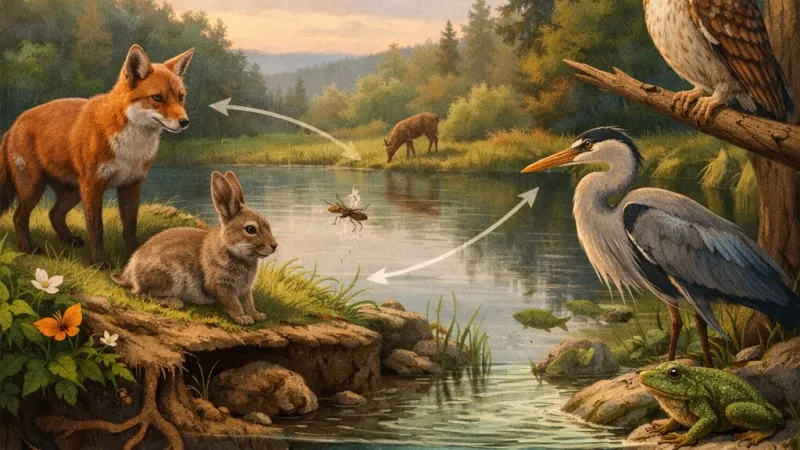
Predation acts as a natural population control mechanism. The classic predator-prey relationship between foxes and rabbits on the English downs follows a cyclical pattern—when rabbit numbers rise, foxes flourish, but increased predation soon causes a decline in rabbit populations, followed inevitably by a drop in fox numbers. This cycle underpins much of the dynamic equilibrium seen in British ecosystems and supports robust biodiversity.---
Adaptations and Natural Selection in Population Survival
Anatomical, Physiological, and Behavioural Adaptations
Living systems constantly evolve to survive their particular environment. In winter, the thick, white coats of Scottish mountain hares provide camouflage against snow and reduce heat loss (anatomical and physiological adaptations). Circadian rhythms and hibernation behaviours, as demonstrated by dormice, represent classic behavioural responses to seasonal scarcity.Adapting to Abiotic Factors
Species often push against the boundaries of their physiological limits. The marsh orchid is adapted for wet, nutrient-poor fens found in Somerset, while lichens on dry, windswept cliffs of Wales must withstand desiccation and intense sunlight. Each adaptation shapes distribution patterns and overall survival.Adapting to Biotic Factors and Natural Selection
Adapting to living pressures—be they from predators, competitors, or pathogens—is just as vital. The mutualistic relationships between flowering plants and their pollinators (such as bees) have driven the co-evolution of flower shape and nectar composition. Over generations, natural selection enhances traits that confer a survival or reproductive advantage, eventually altering the makeup of entire populations under persistent ecological pressures.---
Measuring and Investigating Populations
Measuring Abundance and Distribution
Biologists assess population abundance as the number of individuals per unit area. Methods differ based on mobility: stationary species (like plants) are typically sampled using quadrats that allow precise calculation of density or percentage cover, a technique commonly employed in school-based fieldwork on British grasslands. Mobile organisms, such as beetles, may be caught using pitfall traps, while birds are monitored through point counts or nesting records.Distribution Patterns
Populations rarely distribute themselves evenly. Clumped distributions, such as puffins nesting on exposed coastal ledges, often arise due to patchy resources. Uniform patterns are seen among aggressively territorial species, whereas random dispersal can occur where environmental variation is minimal.Reliable Sampling Methods
Ensuring representative and unbiased samples remains a perennial challenge. Repeat sampling, randomised quadrat placement, and rigorous statistical analysis (for example, using the mark-release-recapture method for butterflies in wildlife reserves) all contribute to more accurate population estimates, which are crucial for reliable ecological studies and subsequent management decisions.---
Case Studies and British Examples
In the UK, predator-prey relationships attract ready study, such as monitoring vole and barn owl numbers in farmland ecosystems. British native blue tits and great tits—two similar species—demonstrate niche partitioning by choosing different foraging heights or plant types, minimising direct competition. The resilience and adaptation of Scottish pine martens, once threatened but now recovering in regions of Scotland, illustrate the success of conservation strategies grounded in population ecology. Similarly, ongoing work in UK national parks monitors the response of native flora and fauna to changing rainfall and temperature patterns, showcasing the real-world relevance of these principles.---
Rate:
Log in to rate the work.
Log in