Britain and Europe 1964–1975: Political and Economic Relations Explored
This work has been verified by our teacher: 26.04.2026 at 14:20
Homework type: History essay
Added: 24.04.2026 at 7:52
Summary:
Explore Britain and Europe 1964–1975 political and economic relations to understand key debates, leadership, and Britain's path to joining the EEC.
Britain and Europe, 1964–1975: Navigating Identity, Economics, and Diplomacy
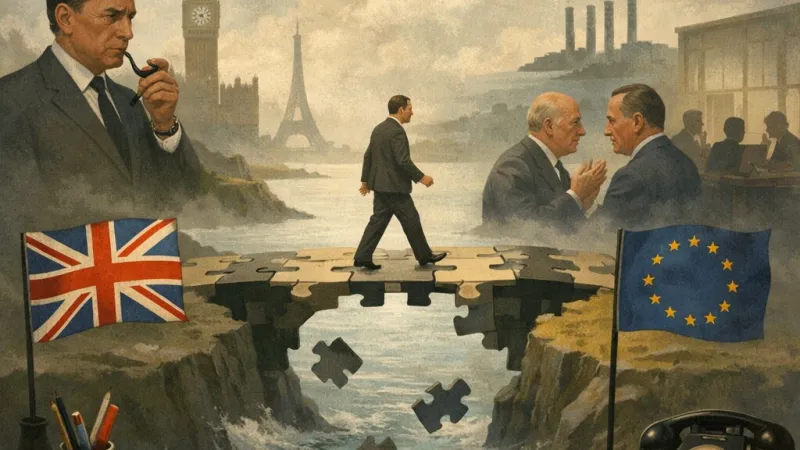
In the two decades following the Second World War, Britain found itself in a period of profound transition. Once the heart of a grand empire, the nation wrestled with its new place in a rapidly changing world, facing the decline of imperial power, shifting international alliances, and the reconstruction of European unity amidst the lingering shadows of war. By 1964, these complex factors had shaped a distinctly ambivalent British stance towards continental Europe. The creation and growing influence of the European Economic Community (EEC) throughout the 1960s and early 1970s posed challenging questions: Should Britain embrace a shared European destiny, or maintain its independence and unique global relationships, particularly the longstanding “special relationship” with the United States and the ties of Commonwealth?
This essay examines Britain’s relations with Europe between 1964 and 1975 through the lenses of political leadership, economic imperatives, diplomatic rivalries, and the pulse of public opinion. By charting the debates, dilemmas, and decisions that culminated in Britain’s entry into the EEC in 1973, I will explore how these years established a precedent for the complex politics of British-European engagement that shaped the nation’s trajectory for decades to come.
I. Political Leadership and Attitudes towards Europe (1964–1975)
A. The Labour Government’s Initial Skepticism (1964–1970)
When Harold Wilson became Prime Minister in 1964, his Labour government approached the prospect of EEC membership with evident caution. Labour was, and remained, a party divided. On the one hand, there were those like Roy Jenkins who argued that Britain belonged at the heart of Europe, seeing membership as a modernising force that could invigorate the British economy and expand social progress. On the other, a powerful strand of Labour’s old guard, many shaped by trade union loyalties and traditional socialism, eyed the EEC with deep suspicion. For them, the treaty of Rome looked uncomfortably like a capitalist club, threatening hard-won sovereignty over economic planning and social protections.Underlying these divisions was a sense, voiced by many on the left, that the EEC’s integration project ran counter to the principle of parliamentary sovereignty—one of the sacred pillars of British political tradition since Magna Carta. At the same time, geopolitics coloured the debate: the Cold War context, along with reliance on the NATO alliance, led some in the Labour ranks to question whether continental commitments might threaten the Atlantic bond with the United States. Wilson was left balancing Europe’s allure against party divisions and geopolitical uncertainties—a balancing act that would continue to characterise Labour’s attitude for decades.
B. Conservative Party’s Advocacy for Europe
The Conservative Party’s approach during this period was more forthright, especially under Edward Heath. Heath was driven by a conviction—rare among post-war British politicians—that Britain’s future depended on European integration. For him, championing entry into the EEC was less a question of economic calculation than an assertion that Britain must not stand isolated on the peripheries of the new Europe. As a party, the Conservatives were not immune to British exceptionalism, but Heath’s leadership shifted the dial. Appointed Prime Minister in 1970, he pressed ahead with urgency, seeking to modernise the economy and reinforce Britain’s place on the world stage.The contrast with prevailing political attitudes was stark: while many in politics and the press clung to memories of imperial grandeur and doubts about ceding autonomy to Brussels, Heath spoke for a vision of Britain as a leading European nation—an argument that, though not universally persuasive within his own party, would prove influential in the coming years.
II. Economic Considerations and Motivations to Join the EEC
A. Britain’s Economic Challenges in the 1960s
By the mid-1960s, Britain’s economic prospects were increasingly troubled. The nation’s celebrated manufacturing sector, once the workshop of the world, was showing its age: productivity growth lagged behind its European neighbours, while traditional industries such as coal and shipbuilding drifted towards decline. The economy was beset by persistent balance of payments crises, with sterling coming under repeated pressure. Successive governments searched for remedies, but each new policy seemed only to stem the tide, not reverse it.In this context, comparisons with the booming economies of France, West Germany, and the Benelux countries were impossible to ignore. These EEC nations were posting impressive growth figures, enjoying increasing living standards and surging rates of investment. Britain, by contrast, was seen to be falling behind, its growth stymied by outdated industrial practices and a shrinking share of world trade.
B. The EEC’s Appeal as an Economic Bloc
Part of the EEC’s allure, therefore, was the promise of access to new, larger markets—an antidote to Britain’s sluggish domestic performance. The prospect of tariff-free trade across a vast common market dazzled many policymakers and business leaders. Modernisers in both parties argued that EEC membership would force British industry to become more competitive, foster much-needed investment, and stimulate innovation.However, there were also misgivings. Concerns about the loss of control over economic policy—especially around agriculture and fisheries, domains central to rural livelihoods—proved stubborn. The question of the Common Agricultural Policy (CAP) was particularly contentious, with critics arguing it privileged continental producers over British farmers. Debates raged in Whitehall and beyond, with anti-marketeers warning that joining the EEC would mean ceding too much sovereignty to Brussels. Proponents, however, insisted that the cost of exclusion—from market and influence alike—would be far greater.
III. Diplomatic Obstacles: France, De Gaulle, and the ‘Special Relationship’
A. France’s Resistance and Charles de Gaulle’s Vetoes
If Britain’s internal debates were complex, its European negotiations were equally fraught. Twice during the 1960s, French President Charles de Gaulle vetoed British applications to the EEC, famously invoking his “non” in 1963 and again in 1967. For de Gaulle, British membership was undesirable for several reasons. He saw Britain as too closely tied to the United States, suspecting that American influence would undermine the vision of a Europe independent of superpower control. The “special relationship” thus became, perversely, a kind of diplomatic poison—an asset in Cold War defence, but a liability on the European stage.B. Negotiation Efforts and Diplomatic Tensions
Britain’s diplomatic pursuit during the Labour and early Conservative governments thus took on a repetitive pattern: overtures, negotiation, rebuff. Prime Ministerial missions to Paris were often exercises in frustration. Ministers sought to reassure their continental counterparts that Britain was committed to Europe, not just to bolstering its own position vis-à-vis the United States. British diplomats, through public and private channels, emphasised support for European cooperation—from pledges of engagement in the Council of Europe to commitments to European defence. Nevertheless, the shadow of earlier imperial pretensions and transatlantic ties was difficult to dispel.C. Changing French Attitudes and EEC Enlargement
The breakthrough would come only after de Gaulle’s resignation in 1969. His successor, Georges Pompidou, while still cautious, was more pragmatic. This shift in French policy, combined with growing EEC recognition that expansion would strengthen the community, finally opened a path for British entry. The negotiations that followed were marked by compromise and careful balancing of interests—over budget contributions, agricultural policy, and protection for domestic industries. Ultimately, it was a triumph of patience and persistence over the bitterness of past failures.IV. Domestic Politics and Public Opinion in Britain
A. Parliamentary Debates and Party Divisions
Within Westminster, debates over Europe were intense and often acrimonious. Key parliamentary speeches, such as those by Enoch Powell warning of “the loss of parliamentary control,” revealed deep anxieties. Meanwhile, prominent pro-Europeans like Jenkins and Heath sought to persuade colleagues and country of the benefits of membership. The media played a central role, with newspapers including The Times and The Guardian frequently weighing in on both sides. Pressure groups—from the Federation of British Industry to the National Farmers’ Union—lobbied relentlessly to influence government positions.B. Public Perception and Referendum Campaigns
Even as the political elite debated, British public opinion remained divided. Early polling indicated suspicion or even hostility, with many recalling wartime rivalries or expressing concerns about sovereignty. However, as the economic argument gained traction—and as politicians and campaigners stepped up educational efforts—a more nuanced view began to emerge. By 1975, Wilson’s government, seeking to resolve intra-party tensions and democratic legitimacy, called for a national referendum on continued EEC membership. This was Britain’s first major public vote on a European question, a precursor to the historic referenda of later decades. The campaigns were emotive and fiercely fought, but in the end, a substantial majority backed staying in the community—an indication that the economic and political case had found resonance beyond Westminster.V. Britain’s Entry into the EEC in 1973 and Immediate Aftermath
A. Formal Accession under Edward Heath
On 1st January 1973, Britain finally joined the EEC, alongside Denmark and Ireland. The terms were the product of protracted negotiation—compromises on budgetary contributions, phased adjustments for agriculture and fisheries, and specific carve-outs for sensitive industries. Supporters hailed it as a new dawn, a chance for Britain to rejuvenate its economy and claim its place as a leader in European affairs. Detractors, however, lamented the loss of certain controls and warned that Britain’s unique interests might yet be sidelined in a continent-wide community.B. Early Impacts on British Politics and Economy
The initial years of EEC membership saw mixed results. While there were upticks in investment and some evidence of economic modernisation, the hoped-for transformation did not arrive overnight. Inflation and industrial unrest persisted, compounding the challenges of the 1970s. Politically, bitter divisions within the major parties continued—with Labour, in particular, riven by Eurosceptic backbenchers and pro-European pragmatists. The role of Britain within EEC institutions was still evolving, and the question of how to balance European obligations with domestic priorities would return, time and again, to dominate the national conversation.Conclusion
Between 1964 and 1975, Britain’s route to Europe was anything but straightforward. Political leadership vacillated between cautious engagement and visionary advocacy, while economic woes both encouraged and complicated the case for integration. Diplomacy was marked by repeated setbacks, most famously at the hands of de Gaulle, yet ultimately perseverance and shifting continental attitudes prevailed. Domestically, debates over sovereignty, identity, and economic self-determination exposed raw nerves—debates that would echo down the years.The legacy of this extraordinary period is enduring. Britain’s accession to the EEC was not merely an act of economic calculation or diplomatic necessity; it was a reckoning with national identity and historical destiny. Understanding the entanglements and arguments of these years reveals much about the challenges that would later emerge in British-European relations, from the Maastricht Treaty to Brexit. Above all, it underscores the perennial tension in Britain’s self-conception: an island nation, at once apart from and inevitably bound to the fate of the European continent.
Rate:
Log in to rate the work.
Log in