An Analysis of Germany’s Weimar Republic Recovery from 1924 to 1929
This work has been verified by our teacher: 21.04.2026 at 15:51
Homework type: History essay
Added: 20.04.2026 at 6:23
Summary:
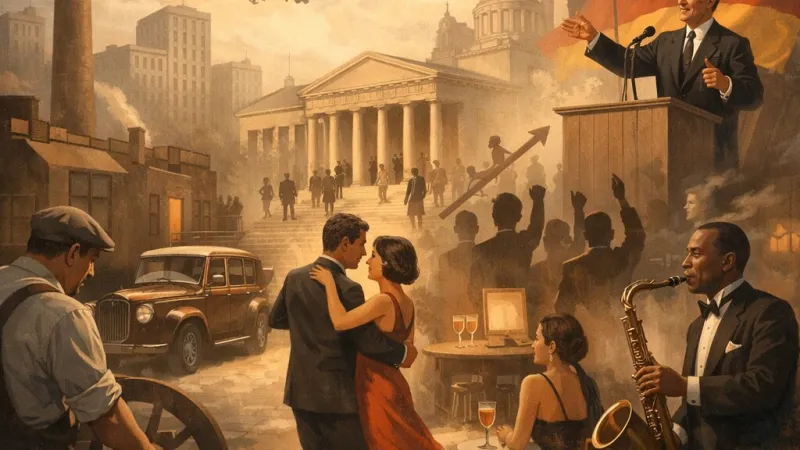
Explore Germany’s Weimar Republic recovery from 1924 to 1929, learning how economic and political changes shaped this crucial historical period.
Weimar Recovery 1924–1929
The Weimar Republic, born amidst the ruins of imperial Germany in 1919, emerged into a world defined by humiliation, deprivation, and suspicion. The Treaty of Versailles, notorious for its punitive terms, left Germany reeling: the nation faced colossal reparation payments, territorial losses, and a sense of national dishonour. In the early 1920s, these wounds were compounded by skyrocketing inflation, political violence in the streets, and challenges to the legitimacy of democratic government from both Left and Right. However, between 1924 and 1929, the Weimar Republic experienced a striking, if temporary, recovery. Through economic stabilisation, diplomatic realignments—most notably under Gustav Stresemann—and partial political accommodation, Germany achieved a period of comparative calm and prosperity. Yet, as this essay will demonstrate, this recovery was always fragile, reliant on external goodwill and dogged by recurrent tensions. By examining economic, international, political, and social dimensions, one can better understand both the achievements and the inherent weaknesses of this pivotal period in German—and European—history.
---
Economic Recovery and Stabilisation
Hyperinflation Crisis and Its Resolution
For many Germans, the defining trauma of the early 1920s was the catastrophic hyperinflation that reached its zenith in 1923. The mark plummeted from a relatively stable currency to one worth a fraction of a penny, rendering savings worthless and severing trust between citizen and state. Teachers, civil servants, and pensioners in particular found themselves pauperised overnight. The famous anecdote of shoppers bringing wheelbarrows of cash to purchase a loaf of bread illustrates the surreal nature of this plight.Salvation came through the pragmatic intervention of Hjalmar Schacht, appointed Currency Commissioner that same year. Under his guidance, the Rentenmark was introduced, underpinned not by gold reserves (which Germany lacked) but land and industrial assets, restoring credibility to the currency. This monetary reform, complemented by prudent fiscal policies, arrested the inflation and laid the groundwork for renewed economic confidence.
The Dawes Plan (1924)
Despite this breakthrough, the elephant in the room remained reparations. The Allies’ demand for 132 billion gold marks as compensation for wartime losses had led, indirectly, to the earlier economic meltdown. The Dawes Plan of 1924, brokered largely at British initiative and with active input from Stresemann, was a pivotal moment. It restructured reparations to more manageable annual instalments (initially 1 billion marks, rising thereafter), provided for a substantial loan from American and British banks (totalling almost 800 million marks), and ended the Franco-Belgian occupation of the Ruhr.This plan’s success was immediate: foreign capital flowed in, banks reopened, confidence surged, and unemployment fell. However, critics such as the German nationalist Alfred Hugenberg warned that dependency upon American financial support was itself a risk: “Germany is dancing on a volcano of foreign loans.” Thus, while 1924 saw factories hum anew and the streets of Berlin fill with optimism, there remained an undercurrent of caution about the sustainability of this recovery.
Industrial and Economic Growth
As a result of these reforms, Germany’s economic indicators improved dramatically. Between 1924 and 1929, industrial output quickly rebounded to pre-war levels and then surpassed them. Steel, coal, and chemical industries burgeoned, aided by more efficient management and new investment. Major urban centres—Berlin, Frankfurt, Hamburg—became symbols of modernity, boasting electrification, public transport expansion, and a construction boom. The productivity increases were such that, for much of the middle class and skilled workers, living standards reached heights not seen since before the Great War.Government policy played its part beyond macroeconomics. Social welfare provision was extended; by 1927, unemployment insurance was introduced, providing a measure of protection for the working class. Yet despite these gains, fortunes were uneven: small farmers and rural populations often missed out, exacerbating social divisions that would later resurface.
The Young Plan (1929)
By the end of the decade, the Young Plan attempted to address residual dissatisfaction over reparations. Proposed by a committee chaired by the American Owen D. Young but crucially negotiated by German representatives, it further reduced the overall sum owed and spread repayments over 59 years. While pragmatic, the plan became a lightning rod for right-wing nationalist anger. Campaigns such as the “Law Against the Enslavement of the German People,” spearheaded by Alfred Hugenberg and supported by rising figures like Adolf Hitler, encapsulated the bitterness many still felt.---
Foreign Policy and International Relations
Stresemann’s Diplomatic Strategy
Gustav Stresemann stands out as one of the Republic’s most remarkable statesmen. A former nationalist, Stresemann’s pragmatic embrace of international cooperation and reconciliation did much to end Germany’s diplomatic isolation. His dual roles as Chancellor (briefly) and then Foreign Minister allowed him to pursue what he termed “policy of fulfilment”: observing treaty obligations to secure revision through peaceful means—a marked contrast to the aggressive revisionism that would follow under the Nazis.The Locarno Treaties (1925)
Perhaps Stresemann’s most celebrated diplomatic achievement was the Locarno Treaties of 1925. In these negotiations, Germany recognised its western borders with France and Belgium, while Britain and Italy acted as guarantors of peace. For French statesman Aristide Briand, this pact was about security; for Stresemann, it was about respect. The Treaties did not address Germany’s eastern borders—where territory had been ceded to Poland—but their symbolic importance was immense, signifying Germany’s readmission to the “club of nations”.British historian A.J.P. Taylor called Locarno “the real peace treaty after the First World War.” Britain’s own role as a balance-keeper in Europe was reaffirmed, and the continent entered what many hoped would be a new era of stability.
Germany’s Entry into the League of Nations (1926)
Building on Locarno, Germany was admitted to the League of Nations in 1926, securing a permanent seat on the Council. Stresemann welcomed the move as “bringing Germany back into the great family of nations,” conferring upon his government prestige and the opportunity to influence world affairs peacefully. German membership also quieted some of the concerns among international investors and helped ensure flow of credit would continue.Wider Impact of Improved Foreign Relations
The cumulative effect of these diplomatic advances was to make continental Europe less prone to armed conflict and facilitate the rebuilding of trade. German exports, especially to Britain and France, increased markedly, and international investors began to see Germany as a reliable commercial partner. Where Germany had been a pariah in 1923, by 1929 it was central to plans for economic and political cooperation on the continent.---
Political Landscape: Stability and Continuing Challenges
The Nature of Weimar Democracy
Weimar Germany’s political system was a bold experiment in representative democracy, using proportional representation. This system ensured even small parties could win seats; the Reichstag in Berlin, therefore, came to be dominated by a multitude of parties, reflecting the diversity—and divisions—of German society. Coalition governments were the norm, often unstable and difficult to manage.Rise of Extremist Parties
Although there was a lull in political violence, the Republic was stalked by its adversaries. The Communist Party (KPD) remained strong in Berlin and in many working-class cities; on the right, the National Socialist German Workers’ Party (NSDAP) was still marginal in 1928 but had begun, especially in Bavaria, to attract disillusioned middle-class voters. The political scientist Richard Evans estimates that, although extremists made little electoral progress during the “Golden Twenties,” their mere presence undermined faith in the system.Moderate Parties and Coalitions
The Social Democratic Party (SPD), Centre Party, and liberals worked together to preserve democracy, and for much of this period, chancellors such as Wilhelm Marx and Hermann Müller managed to hold coalitions together with some success. However, these governments were often riven by infighting, and the lack of a strong majority made ambitious reforms and swift action difficult.Societal Divisions and Public Opinion
This was a society still traumatised by war and revolution. Although the economic recovery bred optimism, there was lingering resentment at the Versailles settlement (which many felt humiliated Germany) and suspicion of politicians seen as too eager to compromise. Nationalists railed against “the shame diktat,” and the right-wing press played up stories of corruption and decadence in Weimar’s cities. Even within the SPD’s own ranks there were doubts about the durability of democracy.---
Social and Cultural Dimensions of the Recovery
Living Standards and Social Change
For many Germans, especially in urban areas, the mid to late 1920s brought better wages, decent housing, and an explosion of consumer goods—from radios to motor vehicles. The emergent middle class thrived in Berlin’s cafés, theatres, and department stores. Welfare reforms extended the safety net, improving public confidence in the state, although for agricultural communities and the more conservative rural majority, prosperity was often elusive.Cultural Flourishing: The ‘Golden Twenties’
The Weimar period is remembered in cultural history as an age of remarkable creativity. Berlin rivalled Paris as a centre of the avant-garde: the painter George Grosz lampooned the bourgeoisie, playwrights like Bertolt Brecht challenged conventional morality, and the pioneering films of Fritz Lang explored the anxieties of modernity. For many young Germans—especially women, who gained new rights and freedoms—these were years of hope and experimentation.This “cultural flowering” was, in part, a reaction to the staid conservatism that had gone before, but also a product of greater economic security and the relative stability of street and industry. Yet, these freedoms also provoked a backlash from traditionalists who regarded Berlin nightlife and artistic “degeneracy” as symptoms of moral decline.
Persisting Social Tensions
Not all benefited equally. Employment in key sectors remained fragile, and when international demand wavered, as it did towards 1928, unemployment crept upwards. Rural Germans, especially in the south and east, felt left behind; their sense of exclusion and hostility towards the cosmopolitan metropolises foreshadowed political shifts to come.---
Limitations and Fragilities of the Recovery
Dependence on Foreign Capital
Perhaps the greatest weakness of Weimar’s recovery was that it was built on shaky foundations. Much of the economic revival depended upon loans from Britain and, especially, the United States. While this facilitated rapid modernisation, a sudden call-in of these loans—as would happen after 1929—left Germany frighteningly exposed.Reparations and Nationalist Backlash
Despite the Dawes and Young Plans, reparations never truly left the political agenda. Each new compromise seemed, to some, another surrender. Nationalist parties gained traction with promises to repudiate Berlin’s “fulfilment policy,” capturing popular anger and distaste for foreign tutelage. The repeated debates over “enslavement” helped polarise society and eroded trust in politicians.Underlying Political Instability
Weimar’s coalition schemes remained inherently fragile. Without a tradition of parliamentary compromise and plagued by the constitutional device known as Article 48 (allowing presidential rule by decree in emergencies), the Republic was at perpetual risk. The historian Ian Kershaw has noted that these institutional weaknesses, so apparent during crises, meant “democracy survived in Weimar only because the winds of adversity had calmed.”---
Conclusion
Between 1924 and 1929, the Weimar Republic achieved a remarkable, if precarious, renaissance. Sound economic management, currency reform, and judicious borrowing enabled industry to revive and standards of living to rise, particularly in the cities. Stresemann’s diplomatic wizardry restored Germany to its place among nations and made old enmities seem, for a time, surmountable. At home, political alliances stemmed the tide of extremism, while culture flourished in ways that would echo across Europe.Yet this recovery, for all its glitter, always depended upon external finance, the acceptance of compromise, and a society willing to move beyond past grievances. The fragility was exposed as soon as adversity returned in 1929. Thus, the “Golden Years” of Weimar serve as both an example of what pragmatic leadership and international goodwill can achieve—and a warning of how swiftly progress can unravel in the face of unresolved resentments and structural weakness. This period left a contested legacy, one that remains central to our understanding of both the promises and pitfalls inherent in rebuilding a battered nation.
Rate:
Log in to rate the work.
Log in