An Analytical Study of Dr Lanyon and Mr Utterson in Jekyll and Hyde
This work has been verified by our teacher: 2.05.2026 at 11:07
Homework type: History essay
Added: 29.04.2026 at 9:37
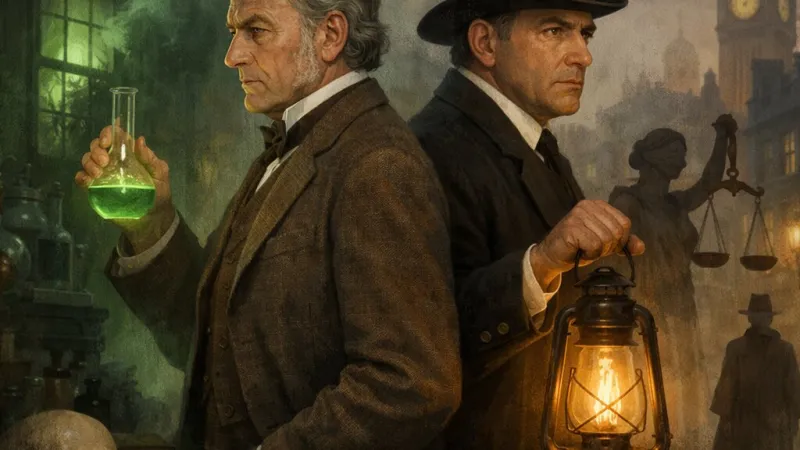
Summary:
Explore the roles of Dr Lanyon and Mr Utterson in Jekyll and Hyde to understand Victorian values, morality, and their impact on the story’s themes.
An In-depth Exploration of Dr Lanyon and Mr Utterson in *The Strange Case of Dr Jekyll and Mr Hyde*
Robert Louis Stevenson’s *The Strange Case of Dr Jekyll and Mr Hyde* endures as a haunting exploration of duality, morality, and the precarious boundaries of Victorian respectability. Though much critical attention has been devoted to Dr Jekyll and his alter ego, Mr Hyde, the figures of Dr Hastie Lanyon and Mr Gabriel John Utterson are equally vital to the novella’s richness. Their roles are not peripheral; rather, they provide vital counterpoints that illuminate the story’s most profound themes. In examining these two characters, it becomes clear that while Dr Lanyon and Mr Utterson both act as rational anchors in a world threatened by the inexplicable, their distinctive personalities, values, and responses to unfolding events shed light on Victorian ideals regarding science, friendship, and moral conduct. Through their contrasting yet complementary perspectives, Stevenson probes the anxieties that haunted Victorian society and still resonate today.
I. Background and Social Context
To appreciate Lanyon and Utterson’s significance, it is essential to situate them within the world of late nineteenth-century Britain. Victorian society was deeply preoccupied with outward reputation and the maintenance of decorum, as evidenced by countless literary works of the era—from Dickens’s rigid social hierarchies to Wilde’s satirical comedies of manners. In *Jekyll and Hyde*, these values are palpable: propriety is everything, and characters measure themselves (and each other) by how scrupulously they adhere to social codes. Scientific discovery, meanwhile, was accelerating at an unprecedented pace. As new theories—most notably Darwin’s evolutionary ideas—challenged religious and moral orthodoxies, the tension between empirical science and established morality intensified.Against this backdrop, Dr Lanyon and Mr Utterson are emblematic figures of their class and time. Dr Lanyon is an established medical practitioner, respected among his peers for his down-to-earth approach and symbolising that branch of science rooted in established fact rather than speculative theory. Mr Utterson, meanwhile, is a solicitor—an occupation highly regarded for its association with integrity, discretion, and guardianship of the law. Both are quintessentially middle-class, informed by Victorian attitudes to discipline, duty, and the importance of upholding one’s reputation. Thus, they represent not merely individuals, but the very values under assault within the novella’s disturbing narrative.
II. Character Analysis of Mr Gabriel John Utterson
Of all the characters in Stevenson’s novella, Mr Utterson stands as the most steadfast and reliable. From the opening chapter, he is the reader’s surrogate—a “dreary yet lovable” figure whose calm rationalism sets the tone for the story’s unfolding. It is through Utterson’s eyes that we first encounter the mystery, his measured investigations drawing us gradually into the heart of the narrative.Utterson’s foremost trait is his rationality. In scenes thick with rumour and suggestion, he remains calm and methodical, refusing to rush to judgement. When confronted with the curious and disturbing situation involving Mr Hyde’s violence, he does not succumb to hysteria or gossip, but seeks evidence and logical explanation. This makes him a stabilising force, reminiscent of other Victorian narrators such as Charles Dickens’s Pip or Wilkie Collins’s Walter Hartright—characters whose efforts to impose order stand in contrast to the disorder swirling around them.
Yet Utterson’s rationality is not cold; it is bound to a deep sense of loyalty and compassion. His devotion to Jekyll transcends mere professional duty, revealing a man whose concern for his friend shapes his every action. When Jekyll becomes increasingly withdrawn, Utterson’s anxiety is palpable. He visits repeatedly, seeking reassurance—and when finally confronted with Jekyll’s apparent downfall, his instinct is not to condemn but to protect. This aspect of Utterson’s personality embodies the Victorian ideal of gentlemanly friendship. It also renders the story’s events all the more tragic; Utterson’s restraint, his repression of feeling, means that vital truths remain just out of reach until the very end.
As a narrator, Utterson frames the story with a mixture of objectivity and limitation. Stevenson cleverly employs him neither as a wholly omniscient nor inept observer; instead, his perspective is marked by a combination of perceptiveness and involuntary blindness. Perhaps his greatest flaw is this self-imposed ignorance—the “backward glance” that avoids what is too unsettling to contemplate. In this way, he symbolises the era’s unwillingness to confront uncomfortable realities: repression, both personal and societal, is his blind spot.
Utterson’s encounters with Hyde serve as a potent lens through which to consider society’s attitudes towards evil. His discomfort and distaste for the criminal figure reflect the Victorian impulse to shun that which is dark or corrupt, clinging to the notion that appearance and respectability can serve as moral guarantees. Yet, for all his uprightness, Utterson is also prepared to question, to dig beneath the veneer of propriety in search of truth—a quality that makes his journey towards enlightenment both compelling and sympathetic.
III. Character Analysis of Dr Hastie Lanyon
Dr Hastie Lanyon, by contrast, stands less as the investigator and more as the implacable guardian of scientific orthodoxy. He emerges from the narrative as a figure of solid rationalism: practical minded, direct, and free from superstition. Where Jekyll is eager to transgress boundaries in pursuit of discovery, Lanyon is steadfastly wedded to the values of empirical science as they were understood in his time.This inflexibility is evident in his fallout with Jekyll over the latter’s “unscientific balderdash.” While Jekyll pursues the mysterious and metaphysical, Lanyon remains anchored in the material and observable world, refusing to countenance speculation unsupported by experiment. On one hand, this makes Lanyon admirable—a man of conviction, unwilling to compromise intellectual integrity for fashion or novelty. On the other, it makes him limited: dismissive of ideas he cannot categorically prove, and unprepared for the shock of encountering the truly inexplicable.
Lanyon’s pivotal role emerges during the climactic revelation of Jekyll’s secret. Unlike Utterson’s gradual approach to the truth, Lanyon is confronted head-on with the horrifying reality of Jekyll’s transformation. His reaction—abhorrence, incredulity, and soon after, death—exposes the vulnerability of the rational mind when forced to confront phenomena beyond comprehension. In this, Lanyon is tragically Victorian: undone by knowledge that defies the very certainties on which he built his life. His death is among the novella’s most powerful statements, not only as a narrative turning point, but as a cautionary illustration of the perils of transgressing scientific and moral boundaries.
IV. Comparative Analysis: Contrasts and Parallels
Utterson and Lanyon are united by their rationalism, yet the manner and outcome of their reasoned approaches diverge markedly. Utterson, the lawyer, applies logic with patience, probing steadily for facts and interpretation. Whilst he is frequently baffled and troubled by the events surrounding Jekyll, his response is to persevere, to reconcile the strange within a framework of law and ethics. Lanyon, on the other hand, as a man of science, expects the world to conform to principles that can be demonstrated and repeated. When faced with something that cannot be explained, he breaks—retreating both emotionally and physically from the world.These reactions are informed by the period’s broader attitudes. Emotional restraint was prized; men were expected to maintain composure and avoid displays of distress. Utterson exemplifies this: anxious but dignified, he seeks solutions even in confusion. Lanyon’s response—overwhelmed by horror and ultimately destroyed by what he learns—suggests the toll taken by new scientific realities and the psychological dangers of forced confrontation with the unknown.
Their relationships with Jekyll also cast light on their characters. Utterson’s loyalty endures, even as Jekyll becomes increasingly enigmatic. Lanyon, conversely, severs ties rather than accept Jekyll’s unorthodox pursuits. Here the reader sees not just a private falling-out, but the immense pressures Victorian professionals faced to conform—friendship was always secondary to principle. And yet, both men’s choices reveal different truths about Jekyll: the loyalty he inspires, the isolation his double life creates, and the tragedy of a gifted individual crushed by social censure and internal conflict.
Symbolically, Utterson operates as the novel’s conscience, a mediator between good and evil—never wholly grasping the depths of depravity, but unwilling to let it pass unchecked. Lanyon, in contrast, stands for the dangers of intellectual inflexibility, his decline serving as a grim warning for those who cannot (or will not) expand their notion of what is possible.
V. Thematic Significance
Stevenson uses Utterson and Lanyon as vehicles to explore some of the novella’s deepest themes. The duality that lies at the heart of *Jekyll and Hyde* is reflected not just in the protagonist’s split self, but in the differing ways these two men approach the world: reason versus emotion, loyalty versus principle, open-mindedness versus rigidity. Victorian fears about scientific progress—complicated by recent advances such as galvanism and perceptions of “mad” experimentation—loom large in Lanyon’s fate, while concerns about personal integrity and social duty permeate Utterson’s response to the scandal around his friend.The pair also highlight the complex codes that governed male friendship. Their struggles to balance personal affection against social expectation remind the reader that even the most rational individuals are hemmed in by forces beyond their control. Stevenson's use of narrative points of view further reinforces the tension: Utterson’s investigative account teases the mystery out slowly, while Lanyon’s devastating testimony delivers a hammer-blow of revelation that shatters all remaining certainties. Together, their experiences accentuate the novella’s resonant anxieties about concealment, taboo, and the limits of reason.
Rate:
Log in to rate the work.
Log in