Explore the causes, global impact, and key events of the Korean War 1950-1953 to understand its role in Cold War history and international relations.
The Korean War, 1950–1953: Unfolding a Divided Peninsula
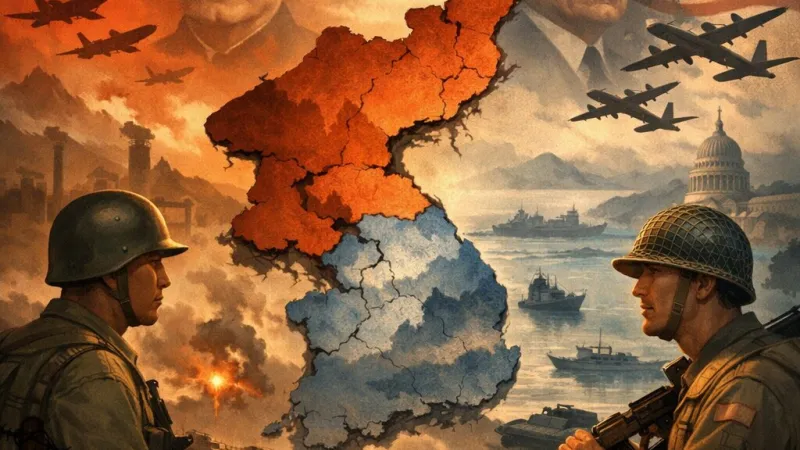
In the aftermath of the Second World War, the Korean peninsula emerged as an unexpected crucible for Cold War anxieties, setting in motion events that would resonate across decades and continents. This war, fought from 1950 to 1953, was both a civil conflict and an international confrontation, pitting North against South, communism against capitalism, and ultimately drawing in global powers including Britain, China, and the United States. The shadow of Korea’s earlier occupation by Japan, combined with the superpower rivalries of the post-war period, created a volatile environment that erupted into open warfare.
Despite playing a pivotal role in shaping modern East Asia and setting precedents for international conflict, the Korean War has often been overshadowed in European classrooms by the conflagrations that bookended it. Yet, its importance—both as a catalyst for Cold War escalations and as a human tragedy—cannot be overstated. This essay will delve into the complex prelude to war, analysis of the military campaigns, the international entanglements, the social and humanitarian devastation, and the enduring legacies which still shadow the Koreas and influence global relations.
I. Historical and Political Background Leading up to the Korean War
The Division of Korea Post-World War II
The origins of the Korean War cannot be disentangled from the division of Korea in 1945. With Japan’s sudden surrender, Korea’s forty-year colonial subjugation ended. Yet liberation brought its own misfortune; in an arbitrary decision by the United States and the Soviet Union, the peninsula was split at the 38th parallel. The Soviets administered the North, and the Americans the South, each fostering governments amenable to their own political systems. Kim Il-sung, a veteran communist guerrilla, emerged as the leader of the North, promoting a vision of reunification under socialism with support from Moscow. In contrast, the South saw the rise of Syngman Rhee, a fiercely anti-communist nationalist, who even before the outbreak of full-scale war had entrenched his authority through political and military suppression.
Political Instability and Tensions in the South
The South Korean regime quickly encountered deep-rooted instability. President Rhee’s government, lacking broad popular support, responded to dissent with repression. Suspected leftists, trade unionists, and peasant groups facing hardship from uneven land reform and economic privation, were often targeted as communist sympathisers—leading to infamous incidents such as the Jeju Uprising, where thousands were killed. The North, meanwhile, embarked on radical land and social reforms, but not without considerable brutalities of its own. The contrasting trajectories of both states only heightened mutual suspicion and increased the likelihood of conflict, creating an atmosphere ripe for wider escalation.
International Geopolitical Dynamics
The wider context of the emerging Cold War was decisive. The late 1940s witnessed the deepening divide between the Soviet Bloc and the western powers. The United States, influenced by George Kennan’s policy of containment, sought to limit the spread of communism beyond its perceived heartlands. The USSR, meanwhile, aimed to consolidate and extend communism’s gains. With China’s own revolution concluding in 1949, the stage was set for the Korean peninsula to become the first ‘hot war’ of the Cold War. British policymakers, deeply invested in multilateral approaches as symbolised by the United Nations, watched uneasily as tensions mounted, aware that war in Korea might have profound implications for the balance of power in Asia and beyond.
II. Outbreak of the Korean War and Initial Phase (June–September 1950)
The North Korean Invasion
The war began abruptly in the early hours of 25 June 1950, when North Korean troops, equipped with Soviet tanks and artillery, surged across the 38th parallel. Within days, their forces captured Seoul, driving the unprepared and poorly equipped South Korean army southward in chaotic retreat. Kim Il-sung justified the attack as a campaign for national reconciliation, though the reality was a high-risk gamble for communist unification.
Humanitarian and Political Repercussions
For Korean civilians, the suddenness and ferocity of the war were devastating. Towns and villages rapidly changed hands, subjecting local populations to accusations of collaboration and subsequent reprisals. In the South, Rhee’s government responded with increased repression, with thousands executed or imprisoned on suspicion of aiding the North. From a humanitarian perspective, families were shattered, millions were displaced, and the trauma wrought by this immediate phase would linger for generations.
United Nations and United States Response
The response was swift: the United Nations Security Council, in an extraordinary move (made possible by the Soviet Union's absence), authorised military intervention to repel the North Korean invasion. British, Australian, and other Commonwealth forces joined the United States-led military operation. President Truman’s decision to intervene was underpinned by the memory of appeasement in the 1930s and a determination not to let Korea slip into the communist bloc. For many in Westminster, fears of the Domino Effect—a belief that if Korea fell, other Asian countries might follow—were paramount.
III. The Course of the War: Key Campaigns and Turning Points
The Battle of Pusan Perimeter
By August 1950, South Korean and UN troops had retreated across the peninsula, establishing a tenuous hold over a small area around Pusan. Here, British soldiers, alongside Americans, Australians, and South Korean forces, held out against repeated assaults. The Pusan Perimeter represented a last stand—the logistical support made possible by the nearby port, and the arrival of fresh supplies, proved decisive. The courage and resilience in the face of seemingly inevitable defeat shaped later commemorations in both Korea and Britain, exemplifying the determination to resist aggression.
The Inchon Landing and Counteroffensive
In September, General Douglas MacArthur orchestrated a daring amphibious landing at Inchon, far behind enemy lines. The operation—risky due to treacherous tidal conditions and the need for absolute surprise—caught North Korean forces off guard. The recapture of Seoul followed swiftly, and North Korean units retreated in disarray. British warships played crucial roles in naval bombardments, and the swift turnaround was celebrated in western media as a triumph of alliance warfare and military ingenuity.
Advance into the North and Chinese Intervention
The sense of victory proved short-lived. UN forces, emboldened by their success, pressed northwards, reaching the Yalu River on the border with China. But China, regarding the advance as a direct threat, intervened massively in late 1950. Wave after wave of Chinese troops overwhelmed UN positions in freezing winter conditions; the Chosin Reservoir campaign, where Royal Marines fought alongside Americans, became a textbook case of desperate withdrawal under fire. The war thus took on new ferocity, transforming what had been a civil dispute into a full-scale international conflict.
IV. Stalemate and Negotiations (1951–1953)
Trench Warfare and Stalemate
By mid-1951, the front lines had stabilised roughly along the original division at the 38th parallel. Both sides dug defensive positions, leading to a protracted period reminiscent of the First World War’s Western Front. Artillery barrages, raids, and sporadic offensives inflicted heavy casualties but produced little movement. New technologies—such as jet fighters and improved tanks—made little impact on the deadlock. Each incident threatened further escalation, raising anxieties in Westminster, Moscow, and Washington.
Diplomatic Efforts and Armistice
Peace talks began at Kaesong and later at Panmunjom, but negotiations dragged on, hindered by disputes over prisoner repatriation and the boundaries of a potential ceasefire. The British government, committed to multilateralism, pressed for a settlement, though tensions were high. The suffering of prisoners—documented by returning British veterans and the Red Cross—added urgency, revealing the immense human cost of diplomatic inertia.
V. Consequences of the Korean War
Human and Material Costs
The war’s toll was staggering: estimates suggest up to two million civilian deaths and injuries, and both North and South Korea suffered immense destruction. Infrastructures—factories, bridges, and entire cities—lay ruined. The psychological scars remained long after the guns had fallen silent; families separated, and memories of brutality haunted survivors.
The war entrenched authoritarian rule in both Koreas. The North, isolated and militarised, became even more repressive. In the South, anti-communist sentiment became official dogma, with American military and economic interests becoming deeply enmeshed in the state’s reconstruction—an arrangement that mirrored the British experience in post-war Europe under the Marshall Plan, though Korea’s path was far more fraught.
Broader International Repercussions
Globally, the war hardened Cold War divisions, encouraging both NATO’s expansion and the creation of new security arrangements such as SEATO. The Chinese intervention marked China’s emergence as a major regional actor—a reality with which British foreign policy had to reckon in later decades, especially during the Malayan Emergency and the Hong Kong negotiations. The precedent set for UN military intervention, meanwhile, has shaped debates from Suez to Sierra Leone.
VI. Legacy and Historical Interpretation
Memory and Historiography
In Britain, the Korean War is often termed the “Forgotten War”—overshadowed in popular memory by the Second World War and later the Vietnam conflict. Yet in Korea it remains a defining trauma. South Korean education remembrance rituals, and films such as “Taegukgi,” have kept the memory alive, whilst North Korean propaganda frames it as a heroic struggle against imperialist aggression. British scholarship, including works such as Max Hastings’ “The Korean War,” has sought to bring these complexities to the fore, combining military analysis with attention to social impact.
Lessons Learned and Contemporary Relevance
The conflict offers stark lessons: the dangers of ideological rigidity, the risks inherent in escalation, and the suffering wrought by modern warfare. The continuing division of the Korean peninsula—with hostile rhetoric, military exercises, and nuclear threats—serves as a daily reminder that the war’s shadow has not lifted. For international relations students, understanding Korea’s tragedy is crucial to building a more informed, nuanced approach to modern diplomacy and conflict prevention.
Conclusion
The Korean War, although often side-lined in western textbooks, occupies a pivotal role in world history. Its origins in a divided peninsula, shaped by great power rivalries and fractured ideologies, led to a gruelling conflict that cost millions of lives and shaped the modern geopolitical landscape. The war cemented divisions, fuelled the arms race, and tested the resolve of alliances such as the United Nations. More than seven decades on, the lessons—military, political, and ethical—still echo. Only by confronting this past, with all its tragedy and complexity, can we hope to draw insights capable of building a more peaceful future.
Frequently Asked Questions about AI Learning
Answers curated by our team of academic experts
What were the main causes of the Korean War 1950-1953?
The main causes were Korea's division after World War II, political tensions between North and South, and escalating Cold War rivalries between the United States and the Soviet Union.
How did global involvement impact the Korean War 1950-1953?
Global involvement turned the Korean War into an international conflict, with countries like the United States, China, Britain, and the USSR supporting opposing sides and affecting the war’s scale and outcome.
What was the immediate impact of the Korean War 1950-1953 on Korea?
The immediate impact was massive social and humanitarian devastation, including loss of life, destruction of infrastructure, and the continued division of the Korean peninsula.
How did the Korean War 1950-1953 begin?
The war began on 25 June 1950 when North Korean forces, supported by Soviet equipment, invaded South Korea across the 38th parallel, swiftly advancing southward.
Why is the Korean War 1950-1953 significant in Cold War history?
The Korean War marked the first major armed confrontation of the Cold War, setting patterns for future international conflicts and deepening the global divide between communism and capitalism.
Rate:
Log in to rate the work.
Log in