Key Events and Developments of the First Cold War: A Detailed Revision Guide
This work has been verified by our teacher: 22.05.2026 at 9:48
Homework type: History essay
Added: 20.05.2026 at 7:48
Summary:
Explore the key events and developments of the First Cold War to master early diplomacy, ideological clashes, and power politics shaping post-WWII Europe.
The First Cold War: Key Events and Developments – A Comprehensive Revision
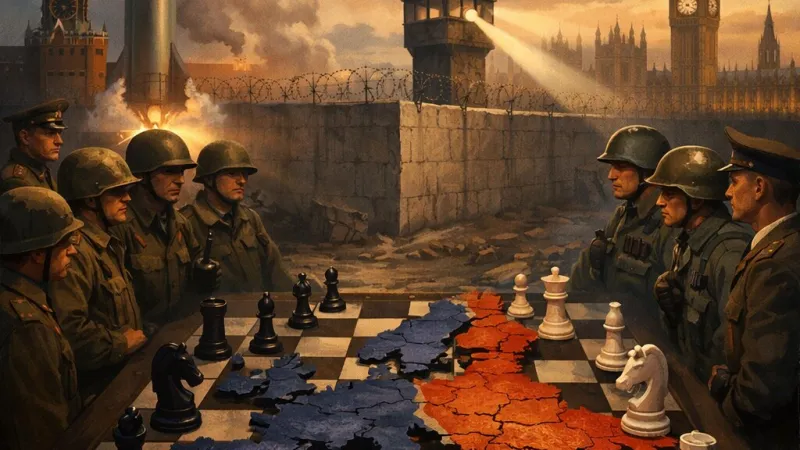
In the aftermath of the Second World War, Europe and much of the world found themselves at the threshold of a new era marked not by open warfare, but by an intense rivalry barely concealed under diplomatic protocol. This period, known as the Cold War, pitted two fundamentally opposing blocs against one another: the capitalist West, led by the United States and ably supported by the United Kingdom, and the socialist East, commanded by the Soviet Union. Though actual combat between these major powers was largely absent, their contest manifested in almost every sphere: political, economic, military, and ideological. To fully grasp later developments, from the Berlin Wall to the Cuban Missile Crisis, it is crucial for students of history to understand the intricate web of alliances, agreements, betrayals, and mistrust which defined the beginning of the Cold War – generally considered to have begun between 1945 and 1949. This essay will critically examine how early diplomacy, ideological confrontation, and power politics shaped the contours of a divided Europe that would endure for decades.
---
I. Setting the Scene: Europe in Ruins and the Collapse of Ally Unity
World War II left the continent of Europe physically devastated and politically unstable. The so-called “Grand Alliance” of the United Kingdom, Soviet Union, and the United States, though highly effective against Nazi Germany, was always a marriage of convenience. As soon as the Axis threat diminished, underlying ideological differences surfaced. The Western allies, including British figures like Winston Churchill and Clement Attlee, looked forward to European reconstruction along democratic capitalist lines, favouring free elections and the revival of independent nation states. In contrast, Stalin's Soviet Union, having borne the brunt of Nazi aggression, sought buffer zones and friendly, if not compliant, governments along its western border to prevent any repeat of such devastation.This divergence was not lost on British policymakers. In the House of Commons, debate often centred upon how to curtail further Soviet expansion in Europe, whilst simultaneously remaining vigilant regarding any resurgence of German militarism. Equally, for the war-ravaged populations of Poland, Hungary, and the Balkans, the “liberation” by Soviet forces soon took on a more ambiguous meaning as Moscow’s influence became increasingly assertive and sometimes oppressive.
---
II. Conferences and Fault Lines: Yalta, Potsdam, and the Birth of Mistrust
To manage both the end of war and the new peace, Allied leaders convened at a series of conferences. The first tangible sign of growing tension came at the Moscow Conference of 1944, most famous for the so-called “Percentages Agreement” scribbled by Churchill and Stalin. This informal document essentially allocated spheres of influence over countries such as Romania, Hungary, Greece, and Bulgaria, sowing seeds of resentment and future dispute as peoples found their fates decided without their say.Early in 1945, the Yalta Conference followed, hosting Churchill, Roosevelt, and Stalin in Crimea. Key agreements included dividing defeated Germany into four occupation zones and supposedly guaranteeing free elections in the nations liberated from the Nazis. However, to many in Britain, Yalta’s vague commitments only masked deeper disagreements that were already surfacing—Poland's government-in-exile in London, for instance, found itself marginalised in favour of pro-Soviet elements.
By the Potsdam Conference in summer 1945, the initial veneer of Allied solidarity had all but vanished. With Churchill replaced mid-conference by Attlee and Roosevelt’s death having brought Truman to power, the mood had shifted. While Germany’s division was rubber-stamped, more contentious was Stalin’s tightening grip over Eastern Europe. The Western powers saw these actions as the first steps towards an expanding “Soviet sphere”; the Soviet leadership, on the other hand, perceived them as necessary defence and just reward for their sacrifices.
These conferences are pivotal for understanding how ambiguity and broken undertakings would haunt international relations in the coming years. Literature such as Alan Bullock’s biography of Ernest Bevin, Foreign Secretary during this period, captures how mistrust, mixed motives, and the desire to avoid another war created unstable compromises.
---
III. Soviet Expansion and Securing the Eastern Bloc
While most Western relief and presence dwindled with peacetime demobilisation, the Soviet Union maintained an enormous military force across Central and Eastern Europe. The Red Army’s presence, combined with manipulation of local Communist parties, allowed Moscow to engineer political takeovers in Poland, Hungary, Bulgaria, and beyond. In some countries, such as Poland, the process required both brute force—the stifling of opposition and, crucially, electoral fraud—and subtlety, exploiting fissures between different political factions.For instance, the Communist regime in Czechoslovakia managed to retain a veneer of legality longer than those elsewhere, maintaining coalition governments before a full Communist coup in 1948. The role of organisations such as Cominform ensured a unified communist front against perceived Western encirclement, while the expulsion or intimidation of domestic rivals stymied all hope of genuine pluralism.
From a British perspective, as historian David Reynolds observes, these developments were deeply alarming, not simply for ideological reasons but also because they threatened the restoration of a “balance of power” system which British diplomacy had prized for centuries.
---
IV. Fracturing Alliances and the Drift to Confrontation
The friction between East and West was not simply born at the conference table. Historical grievances—such as the legacy of the Nazi-Soviet Pact and the fate of the Warsaw Uprising in 1944, during which Soviet forces halted outside the city while the Nazis crushed Polish resistance—deepened the suspicion. The revelation of Soviet responsibility for the Katyn Massacre further poisoned Anglo-Soviet relations, undermining faith in any Soviet promises regarding self-determination for Poland and other states.Into this maelstrom entered Truman, whose approach, signalled most famously through the Truman Doctrine (March 1947), marked a sharp shift from Roosevelt’s conciliatory tone to explicit containment of communism. Aid to Greece and Turkey, threatened by leftist movements, was announced as essential in resisting “totalitarian regimes”. Churchill, though no longer Prime Minister, cast a long shadow: his celebrated ‘Iron Curtain’ speech at Fulton (March 1946) encapsulated perhaps most succinctly the mood in Britain and the West—warning that “from Stettin in the Baltic to Trieste in the Adriatic, an iron curtain has descended across the Continent.”
Intellectual underpinning for Western policy arrived with George Kennan’s “Long Telegram” from Moscow, which—though American—was swiftly analysed and discussed in Whitehall, informing the growing consensus that engagement with the Soviet Union on equal terms was increasingly futile.
---
V. Economic Recovery: The Marshall Plan and the Soviet Riposte
While tanks did not cross frontiers, the struggle for Europe continued through economic means. The British economy, battered by war and reliant upon American loans, strongly supported the launch of the US-led Marshall Plan in 1947. The £13 billion investment (approximately $17 billion at the time) in European recovery was not purely altruistic—a fact recognised by British observers—but also intended to stave off economic depression (and with it, political extremism) in Western Europe.Soviet propaganda denounced the plan as “dollar imperialism” and, under Stalin’s instructions, Eastern bloc countries were forced to reject Marshall aid, further cementing the division between East and West. Instead, Moscow established economic organisations designed to harness its sphere—though often at the cost of growth and living standards in Eastern Europe, especially when compared to the relatively faster recovery seen in the West.
This economic split is evident in contemporary British literature of the time—the post-war austerity novels and memoirs, like those by George Orwell and Anthony Powell, reflect the anxieties of a continent dependent on foreign aid and haunted by recent trauma.
---
VI. Alliances and Reactions: NATO, Cominform, and Mounting Tensions
Events moved inexorably towards institutionalised division. The founding of NATO in 1949, with Britain as a principal member, formalised military cooperation in the face of a suspected Soviet menace. This was soon countered by Stalin’s creation of the Cominform and, later, the Warsaw Pact.The first major crisis came with the Berlin Blockade (1948-49), when Soviet forces cut off all ground access to West Berlin. The subsequent Berlin Airlift, an extraordinary logistical feat supported by both British and American squadrons, proved the resolve of the Western powers and delivered a propaganda victory, reinforcing the image of the West as a defender of freedom amidst communist oppression.
---
VII. The New Map of Europe: Division Entrenched
By 1949, the continent was starkly partitioned. Germany itself was split into the Federal Republic (West) and the German Democratic Republic (East). In the east, Stalinist regimes enforced strict controls, stifling dissent and eliminating political alternatives. Expulsions, repressions, and purges were commonplace, ensuring Moscow’s writ ran unchallenged from the Baltic to the Balkans.Whilst the Western powers, with Britain at the forefront, struggled to maintain influence in Greece and Turkey and help stabilise Italy and France, Eastern Europe’s fate appeared sealed. Only Yugoslavia, under Tito, carved a unique path, breaking with Moscow in 1948—a reminder that the Eastern bloc was far from monolithic.
---
Rate:
Log in to rate the work.
Log in