A Comprehensive Essay on Animal Behaviour for Secondary School OCR
This work has been verified by our teacher: 30.03.2026 at 15:10
Homework type: Essay
Added: 27.03.2026 at 12:03
Summary:
Explore key concepts of animal behaviour for secondary school OCR. Understand biological mechanisms, behaviour types, and scientific study methods. 🐾
OCR Animal Behaviour: A Critical Exploration
Animal behaviour, as a field of study, investigates every facet of how animals interact with their internal and external worlds. It encompasses all actions and reactions – from simple reflexes and elaborate courtship rituals to complex patterns of learning and communication. This topic covers behaviours which are inherited and those which stem from experience, creating a dynamic interface between animal and environment. Understanding animal behaviour is vital, not only for grasping fundamental aspects of biology and the mechanisms underpinning life, but also for appreciating the ecological roles animals play and the evolutionary processes that shape their existence.
Founded on centuries of curiosity, the study of animal behaviour gained scientific footing through the work of pioneers such as Charles Darwin, whose theory of natural selection offered a framework for interpreting behaviour as adaptive. Over time, the field diversified, blending rigorous naturalistic observation with experimental psychology to forge new insights. This essay will examine the historical development and principal theoretical approaches to animal behaviour, classify different behaviour types, interrogate the biological mechanisms at play, explore the methodologies used to study behaviour, and assess the wider applications and future potentials of this fascinating area of biology.
Historical Foundations and Approaches to Animal Behaviour
The formal scientific study of animal behaviour sprouted from two broad traditions: ethology and experimental psychology.Ethology, deeply rooted in European research, focuses on the naturalistic observation of animals in their typical environments. Eminent figures such as Konrad Lorenz, Niko Tinbergen, and Karl von Frisch – all Nobel Laureates – cemented this approach within biological sciences. Lorenz’s demonstration of ‘imprinting’ in greylag geese, a phenomenon where young birds form attachments soon after hatching, remains a classic example of an innate behaviour with immediate survival value. Tinbergen, working on sticklebacks and gulls, emphasised that many behaviours are hardwired as evolutionary adaptations, manifesting as ‘fixed action patterns’ triggered by specific stimuli.
Contrastingly, experimental psychology – particularly behaviourism – arose in laboratory settings, with a focus on the mechanisms by which animals learn through interaction with their environment. Behaviourists like Ivan Pavlov, famed for his classical conditioning of dogs, demonstrated how neutral stimuli (such as a bell) could elicit a response (salivation) through association. More recently, B.F. Skinner’s operant conditioning illustrated how consequences (rewards or punishments) could increase or reduce behavioural responses, a principle widely applied beyond the laboratory, for instance in training guide dogs in the UK to assist the visually impaired.
The debate between “nature” (innate, genetically determined behaviours) and “nurture” (acquired through experience and environment) was once deeply polarised, but modern perspectives in the UK and worldwide now emphasise the intricate interplay of both. For example, the song of the European robin is shaped by a genetic predisposition yet refined through exposure to the calls of other robins, demonstrating that behaviour cannot always be neatly sorted into one category or the other.
Classification and Types of Animal Behaviour
Innate Behaviour
Innate behaviours are those which animals exhibit without prior learning or experience. These can be as basic as the sucking reflex in human infants or as complex as migratory navigation in birds such as the Arctic tern, which travels thousands of miles annually, guided largely by inherited mechanisms. Fixed action patterns, such as the egg-rolling behaviour of greylag geese, exemplify how certain actions are consistent within a species and perform specific adaptive functions, such as ensuring offspring survival.Similarly, taxis (directional responses to stimuli) and kinesis (changes in activity levels) play essential roles, from woodlice seeking moisture to the phototactic movements seen in moths. While innate behaviours offer efficiency and reliability, they may lack flexibility, occasionally leading to maladaptive responses if environments change rapidly.
Learned Behaviour
Learning introduces adaptability. Habituation – the waning response to repeated, non-threatening stimuli – is observable in urban pigeons that no longer flee from passers-by. Through classical conditioning, hounds may come to associate the sound of a lead with walks, displaying excitement at the mere jingle. Operant conditioning underlies more intricate behaviours, such as a Border Collie’s obedience, honed by reward-based training.Observational learning, meanwhile, is striking in species like the great tit, which learned to peck open foil-topped milk bottles, spreading this innovation culturally across regions by copying more experienced individuals. This passing of behavioural traditions – at times described as animal ‘culture’ – blurs the lines between inherited and learned actions, highlighting the richness and diversity of animal societies, even outside primate lineages.
Social Behaviour and Communication
Complex social structures underpin the lives of many animals. Within a troop of baboons at Monkey World in Dorset, for instance, intricate hierarchies determine access to resources and mates through subtle cues and overt dominance displays. Altruism, such as the sentinel behaviour of meerkats, where individuals warn others of predators at their own risk, challenges simple evolutionary logic yet can be understood through kin selection and reciprocal altruism.Communication is pivotal, ranging from the ultrasonic squeaks used by bats to echolocate, to the elaborate dances of honeybees relaying the location of food sources, as demonstrated by von Frisch. These behaviours, whether visual, chemical, or auditory, are vital for survival, mate selection, and cooperation.
Higher-Order Behaviour: Tool Use, Culture, and Cognition
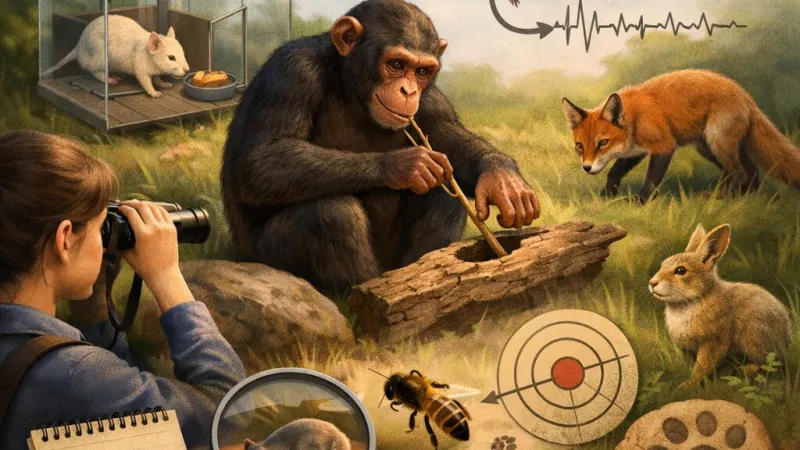
Evidence now abounds for higher cognitive capacities in animals. British corvids such as the rook have displayed remarkable problem-solving skills in laboratory tasks, using stones to raise water levels and access floating food in an echo of Aesop’s fable. The transmission of such techniques between individuals speaks to a form of culture. Similarly, great apes at the Chester Zoo have exhibited tool use to extract insects or crack nuts, evidencing an understanding of causality and foresight. Such studies continue to challenge our assumptions about the boundaries between human and non-human intelligence.The Physiological Basis of Behaviour
Understanding how behaviour arises necessitates a grasp of the underlying physiology.The nervous system, comprising receptors, neurones, and effectors, forms the fundamental pathway for behaviour. A classic example is the withdrawal reflex, as seen in the rapid retraction of a hand from a nettle, where a sensory stimulus triggers a motor response via a reflex arc. More complex behaviours involve integrated neural circuits and higher brain centres, particularly pronounced in mammals and birds.
Chemical messengers, both neurotransmitters (such as dopamine and serotonin) and hormones (including cortisol, adrenaline, and oxytocin), modulate behaviour extensively. In studies of voles, oxytocin has been linked to monogamous pair-bonding, while cortisol levels in stabled horses reflect responses to social stress.
Recent advances in genetics have allowed British researchers to identify gene variants associated with behavioural traits in wild populations. The well-known "foraging" gene in Drosophila fruit flies, for example, affects their propensity to explore or remain sedentary. Additionally, the burgeoning field of epigenetics demonstrates how environmental experiences can induce heritable changes in gene expression, suggesting that behaviour itself can shape biology across generations.
Methods in Animal Behaviour Research
Ethologists and behavioural scientists use a variety of methods to decode animal behaviour.Naturalistic studies, following Jane Goodall’s approach with chimpanzees, remain vital, revealing both the diversity and context-dependency of behaviours. However, this approach – also used by field biologists at the University of Cambridge’s ornithology department – is often complemented by controlled laboratory experiments, where variables can be isolated and precise measurements taken. Classic maze experiments help assess learning in rats, while choice tests gauge mate preferences in sticklebacks.
Comparative studies, contrasting species or populations, shed light on evolutionary pathways. For example, studies comparing song development in isolated and non-isolated populations of blackbirds in urban and rural Britain have revealed the adaptive value of flexible learning in noisy urban environments.
Recent years have seen technologies like GPS tracking and drone observation revolutionise research, while genetic sequencing and neural imaging provide unprecedented insight into the mechanisms underpinning behaviour.
Applications and Ethical Implications
Understanding animal behaviour carries immense practical importance. Conservation initiatives, such as the reintroduction of red kites in the UK, rely on detailed knowledge of species’ territoriality and feeding habits. Zoo management and captive breeding, overseen by bodies like the British and Irish Association of Zoos and Aquariums, benefit from behaviour-based enrichment strategies to ensure animal welfare.In agriculture, manipulating behaviour can improve productivity and welfare – from designing optimal stocking densities for chicken flocks to using pheromone traps to control codling moths in orchards. Recognising animal cognition and welfare, all research and agricultural practices in the UK must adhere to strict ethical codes, as outlined by the Animals (Scientific Procedures) Act 1986, ensuring minimal suffering and humane treatment.
Comparative behaviour research has also enriched our understanding of human psychology – from theories of learning to insights into mental illness and sociality – highlighting the deep evolutionary continuities between humans and other animals.
Contemporary Challenges and Future Directions
In the present climate, animal behaviour research faces new frontiers. Integrating neurogenetics, psychology, ecology and computational approaches offers a more holistic perspective. Researchers at institutions such as UCL and Oxford are investigating how animals adjust their behaviour to cope with rapid environmental changes caused by urbanisation and global warming.Artificial intelligence and machine learning promise to revolutionise data analysis, enabling detection of patterns from massive datasets, such as decades-long seabird breeding records on the Farne Islands. Expanding the focus beyond traditional laboratory models to diverse organisms and wild populations will further enrich our understanding of the behavioural fabric of life.
Rate:
Log in to rate the work.
Log in