The Crucial Functions of Water and Protein Structures in Living Organisms
This work has been verified by our teacher: 9.04.2026 at 13:12
Homework type: Essay
Added: 6.04.2026 at 12:08
Summary:
Discover the vital roles of water and protein structures in living organisms, learning their molecular properties and importance in sustaining life processes.
The Essential Roles of Water and Protein Structure in Biological Systems
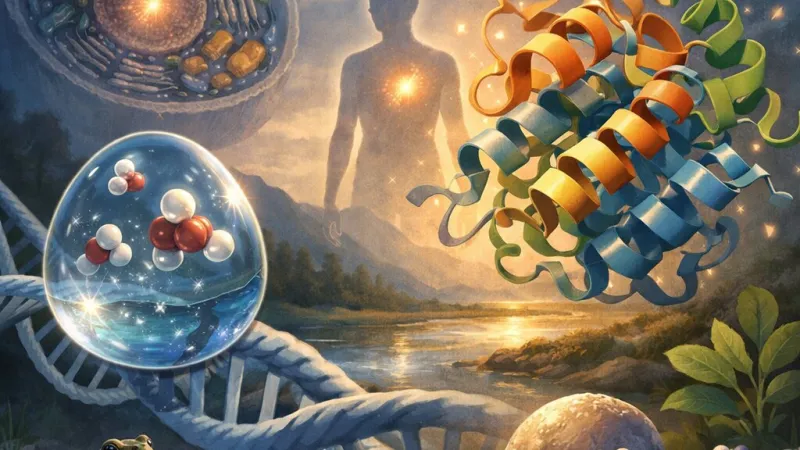
Water and proteins stand as two pillars supporting the complex edifice of life. From the humble grass in the English countryside to the bustling cells within the human body, both these fundamental substances orchestrate a host of vital activities. Water, often deemed 'the matrix of life', has a molecular constitution and a suite of unique physical properties that make it indispensable to living organisms. Proteins, meanwhile, are the versatile macromolecules providing structure, function, and regulation to cells and tissues across all living things. In examining water’s molecular structure and the extraordinary features this imparts—as well as understanding the intricacies of protein structure and its biological importance—one gains a deeper appreciation for life’s delicate balance. This essay explores these molecular marvels, highlighting their properties, interrelationships, and critical roles in sustaining life on Earth.
---
Molecular Structure and Properties of Water
A. Chemical Composition and Molecular Geometry
A molecule of water, familiar as H₂O, comprises two hydrogen atoms covalently bonded to a single oxygen atom. What gives water much of its special character is not merely the identity of these atoms, but also their geometric arrangement. The water molecule adopts a bent or angular shape, with the oxygen atom situated at the apex and hydrogen atoms forming an angle of approximately 104.5°. This shape arises because the pairs of electrons surrounding the oxygen repel one another, pushing the hydrogens closer together. Importantly, the oxygen is notably more electronegative than hydrogen, drawing electrons towards itself and giving rise to a polar covalent bond. As a result, water possesses a dipole—there is a slight negative charge (δ−) near the oxygen and a slight positive charge (δ+) near the hydrogens.B. Hydrogen Bonding: Origin and Characteristics
This polarity enables water molecules to form hydrogen bonds—relatively weak, yet significant, attractions between the δ+ hydrogen of one molecule and the δ− oxygen of another. While a covalent bond binds atoms within a molecule, hydrogen bonds connect separate molecules, forming and breaking with relative ease. It is this transience and flexibility of hydrogen bonding that bestows water with many of its signature properties.C. Impact of Hydrogen Bonding on Physical Properties
The web of hydrogen bonds means water has an unusually high specific heat capacity. A considerable amount of energy is required to disrupt these bonds and increase the water’s temperature. This allows water—whether within the cooling towers of a British nuclear station, the waters of the Lake District, or the blood of a red deer—to buffer temperature fluctuations, maintaining stable conditions vital for chemical reactions and living organisms.Closely related is water’s high latent heat of evaporation. The energy needed to turn liquid water into vapour allows living organisms, like humans, to lose excessive heat via sweating. On hot summer days, a runner in a school sports day at a Sussex field cools down as sweat evaporates, heat energy departing with each droplet.
Yet another remarkable property is water’s high boiling and melting points compared to molecules of similar size, courtesy of those persistent hydrogen bonds. This ensures water remains liquid at the temperatures encountered on Earth, supporting life in ponds, rivers, or within the cytoplasm of a cell.
Unique too is water’s density anomaly. Ice, unlike most solids, is less dense than its liquid state. This stems from the rigid crystalline lattice formed by hydrogen bonds during freezing, keeping molecules further apart. Thus, in a Scottish loch in January, ice floats atop, insulating the water below and allowing fish and other aquatic life to survive the winter months.
---
Water as a Universal Solvent and Its Role in Biology
A. Solvent Properties Linked to Polarity
Water's dipolarity makes it a universal solvent, particularly adept at dissolving ionic compounds and polar molecules. Upon the addition of, for example, sodium chloride, the positive and negative ions become surrounded by water molecules forming hydration shells, effectively separating them and keeping them in solution. This capacity is not simply a laboratory curiosity—it underpins countless physiological processes, such as the dissolution of sugars in plant sap or oxygen in blood plasma.B. Transport and Circulation
Crucially, water acts as a transport medium across different forms of life. In animals, blood plasma comprises mainly water, transporting glucose, urea, hormones, and respiratory gases throughout the body. The British curriculum often references the xylem and phloem in plants: water carries dissolved minerals upwards from root to leaf through xylem, and sugars produced via photosynthesis from leaf to root through phloem. The viscosity of water—a balance between fluidity and internal resistance—ensures materials flow, but not so rapidly as to impair cellular uptake or too sluggishly to be inefficient.---
Mechanical and Surface Properties Associated with Cohesion and Adhesion
A. Cohesion and Surface Tension
Water molecules are adhesive to each other due to hydrogen bonds—a phenomenon known as cohesion. This is observable in surface tension, which enables pond skaters to dance across still ponds without sinking, a familiar sight in many British gardens. Surface tension also helps maintain the shape and stability of cellular membranes, preventing their collapse and enabling diverse cellular architectures.B. Adhesion and Capillary Action
Water’s ability to stick to other surfaces, or adhesion, plays a vital role in capillary action—the process by which water rises up narrow tubes. This is crucial in plants, where water 'climbs' the thin xylem vessels, defying gravity to reach the leaves. The interplay of cohesion and adhesion, thus, is fundamental to transpiration and plant water transport—a process essential for crops, hedgerows, and wild trees throughout the British Isles.---
Structural Basis of Proteins: Amino Acids, Peptide Bonds, and Polypeptides
A. Amino Acid Structure and Diversity
Proteins are polymers formed from amino acids, each comprising a central (alpha) carbon attached to four groups: an amine (-NH₂), a carboxyl (-COOH), a hydrogen, and a variable sidechain or R-group. There are 20 naturally occurring amino acids, differentiated by the chemical nature of their R-groups: polar, non-polar, acidic, basic. This myriad of sidechains enables an astonishing diversity of protein form and function, from the tough keratin of British wool to the globular enzymes in yeast used in brewing.B. Formation of Peptide Bonds and Polypeptide Chains
Amino acids link through peptide bonds—strong covalent links formed via condensation reactions, in which a water molecule is produced and eliminated. These bonds stitch together long polypeptide chains, always oriented from the amino (N-) terminus to the carboxyl (C-) terminus. The sequence of amino acids forms a protein’s primary structure, dictating the ultimate shape and function.C. Levels of Protein Structure
Beyond the linear sequence, protein structure is hierarchically organised. The secondary structure refers to regular patterns like alpha helices and beta sheets, stabilised by hydrogen bonds between backbone atoms. Tertiary structure refers to the complex, unique 3D folding created by interactions among R-groups: hydrophobic interactions, ionic bonds, disulphide bridges, and further hydrogen bonds. In some cases, multiple polypeptide subunits associate, constituting quaternary structure—as seen in haemoglobin, the molecule responsible for transporting oxygen in the blood.---
Interdependence of Water and Protein Function in Biological Organisms
A. Water’s Influence on Protein Folding and Stability
Proteins attain their functional shape partly due to water’s presence. The hydrophobic effect drives non-polar sidechains to cluster away from water, promoting folding into a stable, functional form. Simultaneously, water molecules form hydration shells and hydrogen bonds with polar or charged regions, stabilising the final conformation. Environmental factors such as pH and temperature, both mediated by the aqueous environment, can destabilise proteins, leading to denaturation—a danger keenly appreciated when boiling an egg or considering the effects of fever.B. Proteins and Enzymatic Activities Dependent on Water
Water is actively involved in many biochemical reactions, either as a reactant (in hydrolysis) or as a product (in condensation). Enzymatic activities—central to metabolism—almost always occur in aqueous solution, where water acts as the medium for substrate binding, product release, and allosteric regulation. Without water, processes such as digestion, cellular respiration, and photosynthesis (the latter so crucial for British agriculture) would halt.---
Rate:
Log in to rate the work.
Log in