How Xylem Transports Water in Plants: Structure and Function Explained
This work has been verified by our teacher: 16.04.2026 at 9:48
Homework type: Essay
Added: 15.04.2026 at 6:08
Summary:
Explore how xylem transports water in plants by studying its structure, function, and role in plant hydration for secondary school biology students in the UK.
The Vital Role of Xylem in Plant Water Transport: Structure, Mechanism, and Ecological Relevance
Water is the lifeblood of terrestrial plants. From the initial absorption by roots buried deep in the soil, through to the canopy’s furthest leaf, every cell depends on a continuous supply of water and dissolved minerals. At the heart of this hydraulic system lies an ingenious network of vascular tissue, of which the xylem is the chief conduit. Complemented by the phloem—which distributes organic nutrients—the xylem’s function is singularly adapted for the upward movement of water, ferrying not only liquid but also the minerals underpinning all plant metabolism. Understanding how the xylem achieves this on both a structural and physiological level is not only crucial for plant biologists but also for fields as diverse as crop science, horticulture, and conservation. This essay will critically explore the structure and adaptations of xylem tissue, elucidate the mechanisms of water uptake and upward movement, examine the interplay between transpiration, gas exchange and adaptation, and consider experimental approaches for measuring transpiration. In doing so, it will highlight both the elegance of plant vascular systems and their profound ecological and practical significance.
Structural Features of Xylem: Adaptation for Conduction
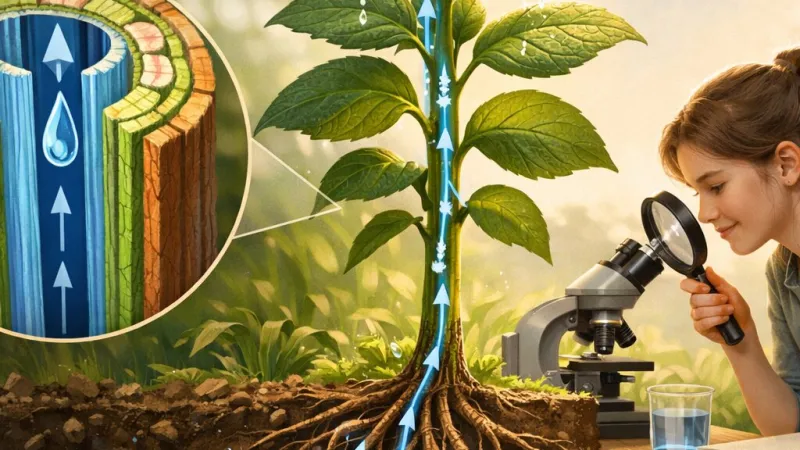
The xylem is, in essence, a highly specialised network of elongated tubes traversing the plant from root to shoot. Its fundamental unit, the xylem vessel, is formed from a longitudinal chain of dead cells—vessel elements and tracheids—whose cross walls typically break down, creating a pipe-like structure uninterrupted from one end to the other. The absence of living contents—no cytoplasm, no nucleus—removes obstacles to flow, enabling a continuous column of water to rise unimpeded.A distinguishing characteristic of xylem tissue is the presence of secondary thickened cell walls reinforced with lignin. Lignin, deposited in various patterns such as spirals and annuli, offers twofold protection. First, it imbues the xylem with immense tensile strength, crucial in withstanding the negative pressures generated during water ascent. Second, it prevents the vessel's collapse, especially under the intense tension created when water evaporates from leaf surfaces.
Xylem walls are also pitted; these minute, unthickened areas serve a vital function in lateral conduction, allowing water and minerals to detour between adjacent vessels, tracheids, and parenchyma cells. This lateral movement is particularly important when the direct path is blocked or when supplying the water-hungry mesophyll cells of leaves. Unlike most plant cells, xylem elements lack plasma membranes at maturity, so water passes freely in and out—a feature indispensable for rapid, large-volume transport.
The Mechanism of Water Uptake and Movement
Uptake at the Roots
The journey begins at the microscopic level, with root hair cells vastly increasing the surface area for water absorption. Root hairs exploit the water potential gradient between the moist soil and the more concentrated solute environment within root cells. Through osmosis, water moves from higher (less negative) to lower (more negative) water potential, entering the root.The Transpiration Stream
Once inside, water traverses the cortex (either via the symplast—through cells—and apoplast—between cell walls) before entering the xylem vessels within the stele. It is here that the unbroken column of water forms the so-called transpiration stream, a continuous pull extending from the roots to every transpiring leaf.The Cohesion-Tension Theory
This upward movement is best explained by the cohesion-tension theory, proposed in the late nineteenth century by British botanist Henry Dixon and his colleague John Joly. As water evaporates from the moist mesophyll cell walls in leaves and diffuses out through stomata—a process termed transpiration—a negative pressure (tension) is established at the upper end of the xylem vessel.The unique chemistry of water, with its capacity for hydrogen bonding, means that as one molecule exits, it “pulls” the next behind it. Cohesion gives the column stability, while adhesion between water molecules and the cellulose lining of xylem walls helps resist the downward force of gravity and prevents the vessel from collapsing inward. Thus, the entire system acts much like a rope: one tug at the leaf end is felt all the way down to the roots.
Water Potential Gradients
The movement is driven by the gradient in water potential, becoming increasingly negative from soil to root to leaf air space. As water evaporates from the cell walls into the air spaces and then out of the stomata, it sets up a chain reaction, drawing more water up from below. This dynamic not only replenishes lost water but also ensures the supply of vital dissolved ions, such as nitrates and magnesium, fundamental for cellular processes like photosynthesis and protein synthesis.Transpiration, Gas Exchange, and Adaptive Features
Gas Exchange and the Transpiration Trade-off
For photosynthesis to proceed, plants must open their stomata to permit carbon dioxide influx—yet this gateway is also the prime exit point for water vapour. Herein lies an evolutionary conundrum: efficient gas exchange inevitably comes at the cost of water loss via transpiration.Natural Consequence and Adaptation
The open, moist surfaces of the mesophyll are ideal for capturing gaseous carbon dioxide but simultaneously allow water to evaporate into the internal leaf air spaces. This, coupled with the presence of large intercellular air spaces, raises the relative humidity and accelerates the diffusion of water vapour out of the plant.To counterbalance these losses, plants have developed an array of adaptations. The most universal is the waxy cuticle on the leaf epidermis, rendering it virtually impermeable to uncontrolled water loss except at stomatal pores. Some plants, such as holly (Ilex aquifolium), exhibit sunken stomata or dense covering of hairs—adaptations seen particularly in dry or windswept British environments, such as heather found across heathlands.
Many plants can adjust their stomatal aperture in response to fluctuating conditions—closing stomata in drought, for instance, to conserve water while accepting the consequent reduction in photosynthesis. These mechanisms provide fine physiological control to complement the passive physical adaptations.
Functions Beyond Water Loss
Transpiration’s reputation as a necessary evil belies its broader importance. Besides delivering minerals to aerial tissues, the loss of water through evaporation also cools leaves—much as sweating does in humans, thus protecting sensitive enzyme systems from overheating during the dog days of summer. Moreover, it is fundamental to the distribution of metabolites and the structural integrity of non-woody stems.Managing Water Flow and Coping with Risk
Risks of Excessive Transpiration
Plants faced with rapid water loss risk cavitation—where dissolved gases form bubbles, breaking the continuity of the water column. Such embolisms can block entire vessels. Lignification and the presence of alternative transport routes limit the impact, but too much tension may nonetheless endanger the plant in especially hot or dry conditions.Structural and Physiological Safeguards
To guard against these hazards, British flora demonstrates a range of anatomical strategies. Trees such as oak (Quercus robur) have sturdy lignified vessels, while further south, Mediterranean species show even more extreme features such as narrow vessels to reduce embolism risk. On a physiological level, plants can close their stomata in response to low humidity or high temperature, and occasionally root pressure—a positive pressure at the base of the xylem—can force water upwards, observed when dew forms as “guttation” on leaf edges in the early morning.Measuring Transpiration: Experimental Approaches
The Use of Potometers
In the laboratory, the rate of transpiration is most commonly estimated using a potometer, a classic device in British classrooms. The apparatus consists of a water reservoir, a capillary tube, and a graduated scale. A healthy shoot, cut under water to prevent air from blocking the xylem, is sealed into the device. As the plant transpires, it draws water from the capillary, moving an air bubble along a scale—enabling quantification of water uptake.Factors Investigated
Many environmental factors known to affect transpiration can be manipulated this way: varying the light source mimics overcast versus sunny British days; changing air flow simulates breezy versus still conditions; altering humidity tests the effect of morning mist or dry summer drought.Experimental Limitations
Despite its ingenuity, the potometer method is indirect; water uptake will not always precisely match water loss, as some is used in turgor maintenance, cell growth, or temporarily stored. Results may differ between species, developmental stages, or even due to the time of day.Conclusion
The transport of water in the xylem represents one of nature’s most elegant physiological feats. From the microporous cell walls of roots to the robust, lignified pipes that span trunk and stem, through the dynamic regulation of pores at each leafy tip, plants maintain a fine balance between survival in dry air and the demands of photosynthesis. Through mechanisms such as the cohesion-tension theory, they harness simple physical laws to fuel a complex biological enterprise.In practical terms, a deeper understanding of xylem function translates directly into agricultural innovation and conservation. As the United Kingdom faces shifting rainfall patterns due to climate change, breeding crops with greater water use efficiency or protecting native flora from drought stress becomes ever more urgent. Advances in imaging—such as magnetic resonance microscopy—and the deciphering of genetic controls over xylem formation promise new solutions for tomorrow’s challenges.
Ultimately, the story of xylem is a celebration of evolutionary ingenuity—how humble plants, anchored to where they sprout, have mastered the art of moving water hundreds of feet into the air, supporting not only their own lives but, by extension, the life of all terrestrial ecosystems.
Rate:
Log in to rate the work.
Log in