Understanding Xylem, Phloem, Transpiration and Translocation in Plants
This work has been verified by our teacher: 4.05.2026 at 13:15
Homework type: Essay
Added: 2.05.2026 at 5:41
Summary:
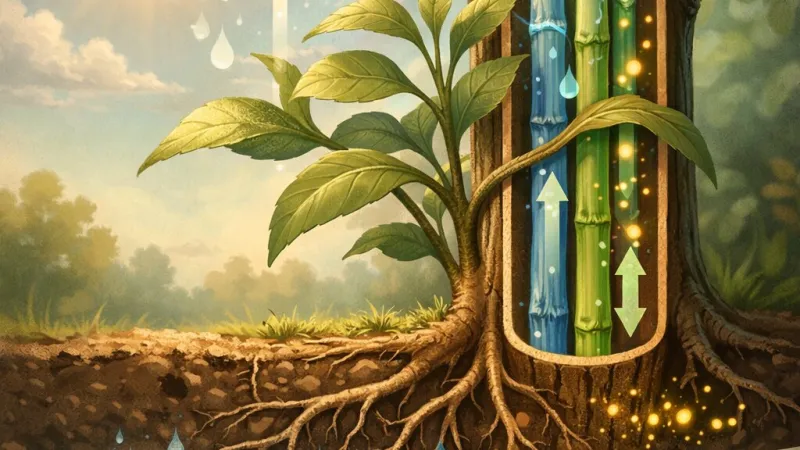
Explore how xylem and phloem tissues work alongside transpiration and translocation to transport water, nutrients, and sugars in plants for exam success.
Introduction
All across the British countryside, from the towering oak trees of Sherwood Forest to the modest bluebells carpeting London’s ancient woodlands, plants thrive through a finely tuned internal plumbing system. At the heart of this system are the vascular tissues—xylem and phloem—which serve as the hidden networks enabling plants to nourish themselves, withstand environmental stresses, and fuel growth. Underpinning these biological phenomena are the crucial processes known as transpiration and translocation, which facilitate the movement of water, minerals, and organic compounds within plants. This essay examines the structure and function of xylem and phloem, delves into the mechanics of transpiration and translocation, and considers their significance in the wider tapestry of plant survival—drawing on notable British flora, classic experiments, and contemporary research to illuminate the subject.---
The Vascular System of Plants: An Overview
The vascular system in vascular plants (tracheophytes) is comparable to the transport systems found in complex organisms, with two main types of tissues providing the means for survival and adaptation. Xylem chiefly transports water and dissolved inorganic nutrients from the soil upwards, while phloem distributes organic substances, such as sugars produced by photosynthesis, around various parts of the plant. This dual system is essential; without it, a beech tree in Yorkshire would no more be able to sustain its uppermost leaves with water than send the products of its leafy photosynthesis to its subterranean root system.Plants’ reliance on these transport systems is evident in the contrast between non-vascular mosses one might find on the stones of Hadrian’s Wall, and the impressive vascularised trees dominating England’s ancient woods. The evolution of efficient vascular tissues enabled plants to colonise new environments, grow taller, and support the lush diversity that defines many British habitats.
---
Xylem: Structure and Function
Xylem tissue is intricately structured for its transport role. It is formed from dead cells aligned end-to-end, creating long, hollow vessels. These vessels are reinforced with thick, lignified walls, which not only confer mechanical strength to the plant (allowing, for example, the stately Scots pine to stand strong against Northumberland gales), but also prevent collapse under the substantial negative pressures generated by water transport.Structural Features for Water Transport
Distinctive features of xylem include pits—tiny, non-lignified areas in cell walls facilitating sideways movement of water—as well as perforation plates which enhance the longitudinal flow. The interconnected vessels form continuous columns, supporting the ascent of water and minerals.
Pathway of Water and Minerals
Water and dissolved minerals are absorbed from the soil by root hairs, pass through the cortex, and enter the xylem. From here, they travel upwards through the stem and into the leaves—the final destination for much of the transported water. As an example, in silver birch trees (Betula pendula), xylem distinguishes itself by adapting structurally to the changing British seasons: broader vessels are produced in spring for maximum growth and water transport, whereas narrower vessels form later, minimising the risk of air blockages (cavitation).
Mechanics of Upward Movement: The Cohesion-Tension Theory
The movement of water in the xylem is explained by the cohesion-tension theory. As water evaporates from the surfaces of mesophyll cells in leaves—a process called transpiration—it creates a negative pressure (tension) that pulls additional water upwards through the xylem. Cohesion, due to hydrogen bonding between water molecules, and adhesion to the xylem walls, help maintain an unbroken column of water. Should this column be disrupted—say, during drought—the danger of cavitation arises, where air bubbles block water flow.
Adaptation to Environment
Xylem adapts according to habitat. For instance, heather on the Scottish moors presents narrow vessels suited to avoid embolisms during spells of water scarcity, whilst water lilies, adapted to pond life, possess wider, more open vessels to maximise hydraulic conductivity.
---
Phloem: Structure and Function
Phloem, in contrast to xylem, is a living tissue, uniquely structured for the transport of organic nutrients. At its core are sieve tube elements—elongated, living cells lacking nuclei, linked by sieve plates (porous end walls) that permit the flow of phloem sap. Each sieve tube element is paired with a companion cell, which controls metabolic functions and is vital in the active loading and unloading of substances into the phloem.Alongside these, phloem fibres provide structural support, while parenchyma functions in the storage and lateral transport of nutrients—features particularly significant in the tubers of the British potato, which store surplus sugars for the harsh winter months.
Function and Direction of Flow
The phloem distributes the products of photosynthesis, predominantly sucrose, from sites of production (‘sources’, such as mature leaves) to sites of utilisation or storage (‘sinks’)—which may be roots, growing shoots, or fruit (as in Kent apple orchards). Unlike xylem, phloem transport is bidirectional, able to send nutrients in several directions depending on developmental stage and environmental cues.
Mechanism: Pressure-Flow Hypothesis
The leading model explaining phloem translocation is the pressure-flow hypothesis. Here, sugars are actively loaded into sieve tubes at the source, increasing solute concentration and causing water to enter by osmosis from adjacent xylem. This builds up a hydrostatic pressure that pushes sap along the sieve tubes. At the sink, sugars are actively or passively removed, reducing pressure and permitting continuous flow. Companion cells are central to this process, orchestrating the active transport of sugars and responding to signalling molecules indicating where resources are needed most (as, for instance, during springtime bud burst in British horse chestnut trees).
Adaptations and Regulation
Phloem is highly responsive: after damage (perhaps from grazing deer in Richmond Park), callose is deposited quickly to seal sieve plates, preventing sap loss and pathogen entry. Regulation also extends to environmental changes, with phloem transport adjusting to temperature and daylight, ensuring that storage organs, like the carrot in a Yorkshire allotment, are efficiently filled with sugars ahead of the colder months.
---
Transpiration: Definition and Biological Significance
Transpiration is the loss of water vapour from plant aerial surfaces, chiefly through stomata—microscopic pores mostly on leaves. The process is central not just to water movement, but to plant homeostasis.Environmental Influences
Transpiration rate is influenced by: - Humidity: High air moisture, as in Cornish ravines, slows transpiration. In dry East Anglian fields, it accelerates. - Temperature: Increased warmth encourages evaporation. - Wind: Breezes remove humid air from around leaves, boosting water loss. - Light Intensity: Promotes stomatal opening for photosynthesis, thus increasing transpiration.
Stomatal density and regulation vary with habitat: shady woodland plants often have fewer stomata compared to sun-baked heather, where gas exchange must be regulated carefully to avoid desiccation.
Physiological Benefits
Transpiration serves several crucial functions. It cools foliage on hot days (helping prevent leaf scorch during English heatwaves), sustains a flow of nutrients from the soil, and maintains cell turgidity necessary for structural support and physiological processes. Fundamentally, the tension it generates in the xylem underpins the entire water transport mechanism.
---
Interrelation of Transpiration, Xylem Transport, and Phloem Translocation
Transpiration, xylem transport, and phloem translocation form a tightly knit triad. By generating negative pressure, transpiration powers xylem flow, drawing up the water and minerals that roots absorb. This water, arriving near photosynthetic cells, is essential not only for metabolism, but also for producing the hydrostatic conditions needed for phloem loading and translocation.Changes in transpiration rate—perhaps due to a dry spell in the Lake District—can markedly affect the efficiency of both xylem and phloem transport. Plants must therefore coordinate stomatal opening, water uptake, nutrient movement, and even growth rate to strike a delicate balance between water conservation and nutrient distribution.
Adaptations to stress are manifold. During drought, many plants (such as Scottish gorse) reduce stomatal aperture, slowing transpiration and conserving water, but at the potential cost of reduced nutrient flow to roots and storage organs. Conversely, some species maintain stomatal opening for longer, risking water loss to sustain vital phloem translocation—striking a compromise to survive.
---
Experimental Evidence and Techniques in Studying Plant Transport
British scientific tradition has contributed much to our understanding here. The classic “ringing” experiments (girdling), which removed a ring of bark (and thus phloem) from trees growing at Kew Gardens, famously caused swelling above the ring—evidence for downward transport of sugars. Histological staining using dyes like safranin and fast green reveals the presence and structure of xylem and phloem, whilst tracer experiments using radioactive isotopes (e.g., radioactively labelled CO₂ in wheat) allow researchers to track the movement of assimilates.Measurement of transpiration rate is routinely achieved with potometers—simple glass apparatus that can be assembled in any British school laboratory to observe uptake and loss of water under varying light, humidity, or wind conditions.
---
Practical Applications and Importance
A deep knowledge of plant transport systems is fundamental to UK agriculture and horticulture. Understanding how to optimise water usage through manipulation of transpiration (for example, by breeding drought-tolerant cereals or using mulches to reduce evaporation in Kent strawberry fields), as well as how to enhance phloem-based nutrient delivery to increase yields, has far-reaching economic implications.Equally, this knowledge is vital in breeding and managing crops that can withstand climate change, which is increasingly impacting Britain’s weather patterns. Studies of plant responses to drought, heat, and flooding inform both classical breeding and modern biotechnology, underpinning efforts to build resilient food systems.
---
Conclusion
Xylem and phloem represent elegant adaptations to terrestrial life, allowing plants, from the ferns of Wales to the rose gardens of Hertfordshire, to thrive and shape their environments. Through transpiration and translocation, they create a dynamic, responsive system that moves water, minerals, and nutrients where needed, powering growth, reproduction, and survival in a changing world. The integration of structure and function seen in these tissues exemplifies nature’s ingenuity, and ongoing research—rooted in the long tradition of British botanical science—continues to deepen our understanding and harness these insights for the future of food, conservation, and human wellbeing.*(Diagram suggestions: labelled images of xylem and phloem structure; arrows illustrating the pressure-flow translocation model; potometer setup diagram.)*
Rate:
Log in to rate the work.
Log in