Understanding Dukkha and Anicca in the Dhammacakkappavattana Sutta
This work has been verified by our teacher: 5.05.2026 at 16:03
Homework type: History essay
Added: 2.05.2026 at 11:30
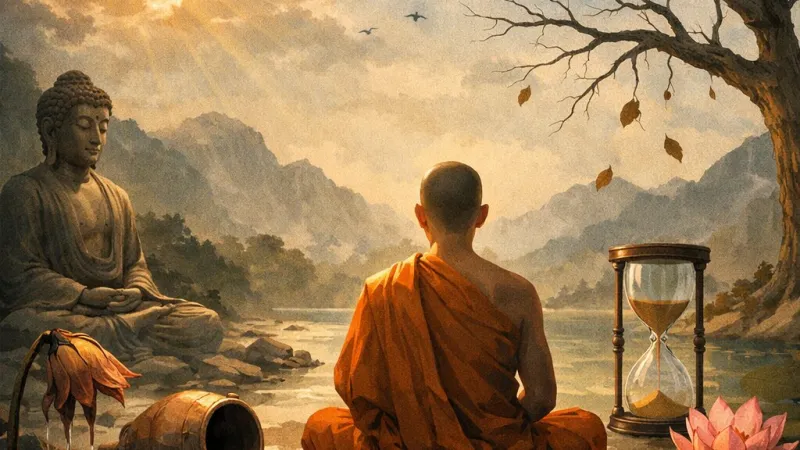
Summary:
Explore the key concepts of dukkha and anicca in the Dhammacakkappavattana Sutta to deepen your understanding of Buddhist philosophy and its teachings.
An In-Depth Exploration of Dukkha and Anicca in the Dhammacakkappavattana Sutta
The early teachings of the Buddha form the very backbone of classical Buddhist philosophy, offering an intricately woven tapestry of insight into the very nature of human existence. At the heart of these foundational doctrines sits the Dhammacakkappavattana Sutta—a sermon often called “Setting the Wheel of Dhamma in Motion.” This inaugural teaching, delivered to the Buddha’s five former ascetic companions in the Deer Park at Sarnath, not only launched the Buddhist community but also set out the Four Noble Truths, fundamentally shaping all subsequent Buddhist understanding.
Within this sermon, the Buddha introduces two core concepts—dukkha, commonly rendered as “suffering,” and anicca, often translated as “impermanence.” Both are presented not as abstract dogma but as essential features of lived experience. The aim of this essay is to examine these two interconnected doctrines as they are articulated in the Dhammacakkappavattana Sutta, interpreting them both within the context of the sutta itself and as part of the broader landscape of Buddhist thought. By exploring the intricacies of dukkha and anicca, we can better understand the Buddha’s profound diagnosis of the human condition, as well as the gateway he opens towards genuine liberation.
Overview of the Dhammacakkappavattana Sutta
The name “Dhammacakkappavattana,” drawing on the Pali language, literally means the “setting in motion of the wheel of the Dhamma” (teaching or truth). The image of the turning wheel symbolises the inauguration of a new spiritual era, in which the Buddha’s vision of reality is made accessible to all who are willing to listen and reflect.The sutta’s substance centres around what are later called the Four Noble Truths—a structure as methodical as it is revolutionary. These are: the truth of dukkha (suffering or unsatisfactoriness), the cause of dukkha (craving), the cessation of dukkha (nirvana), and the path leading to that cessation (the Noble Eightfold Path). By laying out these truths, the Buddha is both diagnosing the core malaise of existence and prescribing its cure.
The audience of the sutta was highly significant. The Buddha chose to deliver his first teaching not to kings or Brahmins, but to his five former companions—ascetics who had shared his earlier journey of extreme austerity. The approach was characteristically direct, yet designed to meet the listeners where they were spiritually: he began by advising a middle way between indulgence and extreme deprivation, then patiently and logically presented his insights. This method reveals the inherently accessible nature of the Buddha’s message—it invites critical reflection and personal investigation rather than blind faith.
Exploring Dukkha: The Reality of Suffering
The Pali word “dukkha” defies any one-to-one translation. While suffering is the common rendering, the concept extends far beyond physical pain or obvious distress. Dukkha encompasses the spectrum of discomfort, unease, disappointment, and existential dissatisfaction threaded throughout life. The Buddha, in the Dhammacakkappavattana Sutta, gives a thorough list: “Birth is dukkha, ageing is dukkha, sickness is dukkha, death is dukkha; sorrow, lamentation, pain, grief and despair are dukkha; association with what is displeasing is dukkha, separation from what is pleasing is dukkha, and not getting what one wants is dukkha.” Even the pleasant moments, under scrutiny, reveal their ultimately unsatisfactory nature when one considers their fleetingness.As the First Noble Truth, dukkha is not intended as a pessimistic view, but as the unvarnished recognition of life’s realities. Admitting suffering as the universal, inescapable condition paves the way for deeper understanding—it is the starting point upon which the rest of Buddhist practice is built. This is why dukkha is not limited to life’s major catastrophes but extends to the subtle disappointments and emotional undercurrents that shape even ordinary days.
The sutta highlights that dukkha is both obvious and hidden: some forms, like physical pain, are plain; others, such as the low-level restlessness and dissatisfaction even amidst apparent joy, are more elusive. This insight resonates with everyday British experience: one might reflect on the let-down of a long-anticipated holiday once it has passed, or the creeping anxiety as exam results approach—moments that, while not severe in the clinical sense, nevertheless unsettle the peace of mind.
Recognising dukkha is a catalyst for transformation. Rather than fostering despair, it encourages students and practitioners to look with clear eyes at the nature of craving and attachment. It is through such honest acknowledgment that one can embark upon the path of ethical conduct, mindfulness, and eventually, liberation.
Investigating Anicca: The Principle of Impermanence
The principle of anicca, or impermanence, is another cornerstone of the Buddha’s inaugural teaching. Found in the changing of seasons on the British isles or the transformation from childhood to adulthood, the reality that all things are in flux is readily observable. Yet, as the Buddha taught, our failure to grasp this truth roots us in continuing distress.Anicca refers specifically to the insubstantial and transient nature inherent in all conditioned phenomena—every object, every sensation, every thought is in a state of constant change. In the sutta, though the word may not be explicit, the Buddha details the ceaseless movement of life: “birth, ageing, sickness, and death.” These are not to be viewed solely as biological events, but as symbols for the ever-shifting nature of existence.
Crucially, the experience of suffering is intimately bound up with impermanence. Pleasures fade, relationships alter, even our identities shift over time. When happiness or stability is sought in any one thing or person, disappointment becomes inevitable as circumstances change. The British poet Percy Bysshe Shelley, in his “Ozymandias,” famously captured this sense of impermanence—monuments to pride and power crumble into the dust, leaving behind only the traces of time’s unstoppable passage.
Understanding anicca is therefore no mere intellectual exercise; it is an invitation to see through illusion. In Buddhist meditation practices—such as mindfulness of breathing or contemplation on the impermanence of body and mind—students learn to observe sensations, mental states, and emotions as ephemeral visitors rather than fixed realities. This insight allows for the gradual loosening of attachment and ego, clearing a path toward wisdom (panna) and freedom from suffering.
The Dynamic Relationship Between Dukkha and Anicca within the Sutta
The interconnectedness of dukkha and anicca is vividly present in the Buddha’s sutta. It is not merely that suffering exists, nor simply that change is constant; rather, it is because phenomena are impermanent (anicca) that suffering (dukkha) arises. For every comfort, the seed of its dissolution is inevitably planted by the very fact of impermanence.The Buddha did not impart these truths as abstract metaphysical claims. Instead, he urged his listeners to observe directly—within their own bodies and minds—the process of arising and passing away. In the early days of the sangha (the monastic community), practitioners were encouraged to develop keen awareness of every moment, noting the arising of a sensation and its inevitable fading, thus piercing the illusion of permanence that underpins craving.
Ethically, the perception of dukkha and anicca helps to cut through desires and aversions, softening attachment to transient pleasures and reducing aversion to fleeting discomfort. The path to awakening, as set out in the last Noble Truth, rests upon this dual insight: that suffering is inescapably woven into all that is ephemeral, and that the only way to peace is to cease clinging to what cannot last.
Broader Significance in Buddhist Philosophy and Practice
Dukkha and anicca are not isolated doctrines but form, alongside anatta (non-self), the three marks of conditioned existence (tilakkhana). These concepts underpin almost all Buddhist schools and sects, from Theravāda traditions preserved in Sri Lankan and Burmese contexts to the Mahāyāna schools found across East Asia. While their interpretations may differ—some Mahāyāna philosophers emphasising emptiness (śūnyatā) as the ultimate extension—they all regard insight into suffering and impermanence as vital steps on the spiritual path.Within contemporary British mindfulness initiatives, such as those in the NHS or university well-being programmes, echoes of these concepts can be seen. When mindfulness trainers in the UK encourage participants to notice thoughts and feelings come and go without attachment, they are, knowingly or not, drawing from the ancient wellspring of dukkha and anicca. There are also striking parallels to acceptance-based therapies employed in modern psychology, which invite people to find peace by letting go of attachment to permanent happiness.
Conclusion
The Dhammacakkappavattana Sutta remains, after centuries, a wellspring of insight into the heart of human life. Through its clear explication of dukkha and anicca, the Buddha offers not only a diagnosis of suffering but also a method for seeing through the illusions that bind us. The interplay between impermanence and unsatisfactoriness is not only a cornerstone of Buddhist philosophy—it is a living reality, recognisable in our own fleeting joys, disappointments, and longings.For students in the United Kingdom and beyond, these teachings invite both reflection and practical engagement. Whether through formal Buddhist practice, self-reflection, or simply a mindful approach to the everyday struggles and pleasures, the wisdom of the sutta offers guidance towards greater understanding, compassion, and serenity.
As we consider our own experiences—succeeding, failing, growing old, or simply facing the uncertainty of tomorrow—the continued relevance of dukkha and anicca is clear. In the end, the path outlined in that ancient teaching remains as vital an invitation today as it did on that first turning of the Wheel of Dhamma: to face the reality of suffering and change, and through that honest encounter, to move towards awakening.
Rate:
Log in to rate the work.
Log in