An Insightful Essay on Islam: Beliefs, Practices and Historical Roots
This work has been verified by our teacher: 8.04.2026 at 16:34
Homework type: Essay
Added: 6.04.2026 at 9:40
Summary:
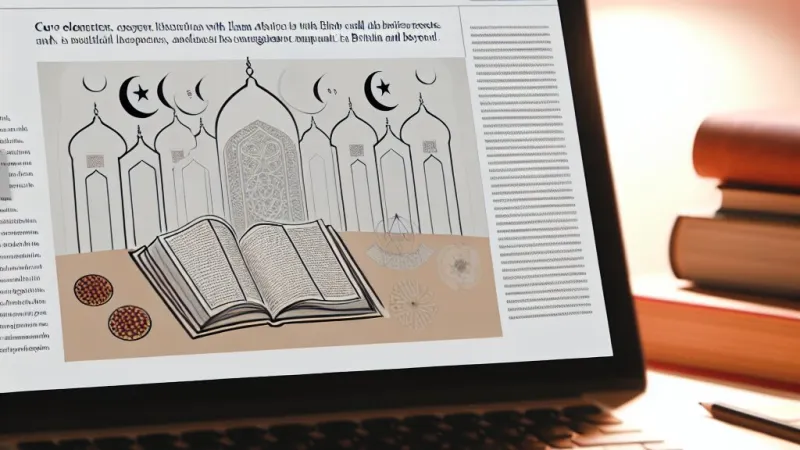
Explore Islam’s core beliefs, practices, and historical roots to gain a clear understanding of its impact and significance in Britain and beyond.
A Comprehensive Exploration of Islam: Beliefs, Practices, and Historical Foundations
Introduction
Islam stands as one of the most significant and influential religions in the world, shaping the lives and cultures of millions, including a growing community within contemporary Britain. Its name, derived from a root word meaning ‘peace’ and ‘submission’, reflects a faith committed to recognising and serving the divine, while fostering a sense of unity and shared moral purpose. With over a billion adherents, Islam touches everything from law and governance to literature, art, and music across diverse societies. Within the British context, an understanding of Islam is not solely an exercise in religious studies but an engagement with a vibrant part of our multicultural fabric.This essay aims to explore the core beliefs, foundational practices, and historical journey of Islam. Central to this exploration will be the Five Pillars of Islam, which construct the daily and spiritual life of Muslims. The essay will also delve into the life and example of the Prophet Muhammad, whose revelations and leadership shaped a new religious and social order in 7th-century Arabia, the ripples of which are still felt today.
Core Beliefs of Islam
The Concept of Tawhid: Oneness of God
At the heart of Islamic belief lies tawhid, the absolute oneness and uniqueness of Allah. This doctrine proclaims that God is singular, undivided and without partners or equals. In the Qur’an, Surah Al-Ikhlas affirms, “Say: He is Allah, One; Allah, the Eternal, Absolute; He begets not, nor is He begotten; and there is none like unto Him” (Qur’an 112:1-4). In strong contrast to the polytheistic traditions prevalent in pre-Islamic Arabia, where tribes worshipped various idols and spirits, the thrust of Islam’s message was uncompromising monotheism.The ninety-nine names attributed to Allah—such as Ar-Rahman (The Compassionate), Al-Khaliq (The Creator), and Al-Hakam (The Judge)—illustrate diverse facets of the divine without fragmenting God’s essential unity. In theological study and daily prayer, these names reinforce the belief that God is infinitely merciful and intimately involved in the world, yet utterly transcendent.
The Role of Prophethood and Muhammad
Prophethood is another spine in the body of Islamic faith. According to Islam, throughout history, God sent many messengers—among them figures familiar from Judaeo-Christian tradition, like Moses (Musa) and Jesus (Isa)—to convey His guidance. Muhammad, born in the trading city of Makkah around 570 CE, is regarded as the final prophet—the Seal of the Prophets. Orphaned as a child and renowned for his integrity (earning the title ‘Al-Amin’, the Trustworthy), Muhammad lived for forty years before receiving his first revelation in the Cave of Hira. It was here that the angel Jibril (Gabriel) delivered the first verses of what would become the Qur’an.Over the next twenty-three years, these revelations continued, addressing spiritual, ethical, and social concerns, laying the bedrock for the faith and community. The reverence for Muhammad is palpable in Muslim practice, where his sayings (hadith) and actions are second only to the Qur’an in authority.
The Qur’an and Hadith as Sources of Islamic Teaching
Muslims regard the Qur’an as the literal word of God, unmatched in its eloquence and authority. It covers every aspect of life—from worship to social justice, from personal morality to commerce. However, for practical guidance on issues not directly addressed in the Qur’an, the Hadith collections, which record the sayings and practices of the Prophet, become crucial. Scholars of Islam (ulama) have long used both Qur’an and Hadith to interpret law (shari’ah) and develop ethical codes. For example, while the Qur’an enjoins prayer, Hadith explain its specific rituals and timings.The Five Pillars of Islam: Framework for Muslim Life
Shahadah: Declaration of Faith
The first and most profound pillar is the Shahadah, an unequivocal declaration: “There is no god but Allah, and Muhammad is the messenger of Allah.” This testimony marks the entry point into Islam and undergirds every aspect of a Muslim’s life. It not only affirms the monotheistic core but also the pivotal role of Muhammad as God’s messenger. The Shahadah unifies the global ummah—regardless of ethnicity or background—in common belief and purpose.Salah: Prayer
Salah, the performance of ritual prayer five times daily, is a striking element of Muslim practice. Adherents ritually wash (wudu), face the Kaaba in Makkah, and recite verses from the Qur’an in Arabic, synchronising millions in shared devotion around the world. In Britain, it is not uncommon to see students and professionals seeking spaces in workplaces or schools to observe these prayers, reflecting adaptability and discipline. Beyond spiritual connection, the communal Friday prayer (Jumu’ah) consolidates a sense of solidarity and mutual support—values championed by British Muslim charities and community organisations.Sawm: Fasting During Ramadan
Each year, Muslims observe the fast of Ramadan, abstaining from food, drink, smoking, and sexual activity from dawn to dusk. This practice, far from being a mere hardship, is seen as a spiritual exercise in self-control and empathy for the less fortunate. As the Qur’an instructs: “O you who believe! Fasting is prescribed to you as it was prescribed to those before you, so that you may learn self-restraint” (Qur’an 2:183). The experience fosters intentionality, gratitude, and community bond, especially during shared iftar meals. In the UK, mosques often become hubs of activity and outreach during Ramadan, extending invitations to neighbours of all backgrounds.Zakah: Almsgiving
The third pillar, zakah, imposes a duty on all Muslims of means to give 2.5% of their savings to support the poor and vulnerable. This is not merely recommended but is regarded as a right of the destitute, aiming to curb economic disparity and foster social cohesion. Voluntary charity (sadaqah) is additionally encouraged—the concept finding echoes in other faith traditions, but here institutionalised in a way that shapes entire societies.Hajj: Pilgrimage to Makkah
Hajj, the pilgrimage to Makkah, is a once-in-a-lifetime obligation for all able-bodied and financially capable Muslims. The rites—circling the Kaaba (tawaf), walking between the hills of Safa and Marwah (sa’i), and standing at Arafat—have both deep historical and symbolic meaning. They commemorate events from the lives of Abraham (Ibrahim), Hagar, and Muhammad. Hajj underscores the equality of believers, who don simple white garments to eliminate divisions of status, and cultivate humility and a sense of global brotherhood.Historical Context and the Life of Prophet Muhammad
Muhammad’s life, as documented by early chroniclers like Ibn Ishaq, straddles the borders between legend and meticulously preserved detail. Orphaned young and known for his honesty, it was his marriage to Khadijah, a respected businesswoman, that provided both emotional and financial support as he embarked on his mission at the age of 40.His call to monotheism challenged the socioeconomic order of Makkah, controlled by powerful clans who profited from polytheist pilgrimage. Early followers faced persecution, with some seeking refuge in Abyssinia. The pivotal moment, however, came with the Hijrah—the migration to Yathrib (later Madinah). More than a physical journey, the Hijrah marks the genesis of the Muslim community, and in fact the starting point of the Islamic calendar. In Madinah, Muhammad negotiated a social contract binding together Muslims, Jews, and other tribes, laying early forms of pluralistic governance.
The subsequent years were marked by conflict and consolidation, notably the battles of Badr and Uhud. Despite adversity, upon his death in 632 CE, Muhammad left a united community, built on a blend of spiritual, ethical, and social reform.
Theological and Ethical Teachings in Islam
A central Islamic teaching is the role of humans as khalifah, or stewards, entrusted with moral responsibility for the earth and its inhabitants. The belief in accountability after death—the Day of Judgement—heightens this sense of purpose and restraint, as described in many Qur’anic passages. Yet divine justice is always balanced with mercy; God is “Oft-Forgiving and Most Merciful” (Qur’an 39:53).Islamic teachings stress charity, truthfulness, respect for parents, and community welfare. Importantly, actions are only as valuable as the sincerity (niyyah) underlying them, as highlighted in a famous hadith: “Actions are judged by intentions.” This focus on inner integrity forms a recurring motif in Islamic ethics.
Contemporary Relevance and Practice
Today, Islam’s reach is global, embracing a multitude of cultures, languages, and jurisprudential schools. Within the UK, Muslims come from varied backgrounds—from families with heritage in Pakistan, Bangladesh, or Somalia, to converts from British backgrounds. There are differences between Sunni and Shia understandings, especially regarding succession after Muhammad, but shared beliefs and practices far outweigh the divisions.Modern British Muslims face unique challenges: negotiating faith identity amid a secular environment, addressing issues of integration and representation, and countering prejudice and misunderstanding. Yet there have been notable contributions: from literature (Moniza Alvi, Sayeeda Warsi) to community projects addressing poverty or youth engagement. Interfaith efforts, such as those by the Christian Muslim Forum, foster dialogue and understanding, reflecting Islam’s continued relevance in shaping a just and harmonious society.
Conclusion
In summary, Islam is founded on the principles of the oneness of God and prophethood. The Five Pillars, grounded in scripture and tradition, establish the pattern of Muslim spiritual and social life. The faith’s historical journey—from the hills of Makkah to the heart of Britain’s multicultural cities—speaks to a message both deeply rooted and enduringly relevant.Islam’s adaptability and spiritual depth have enabled it to thrive across eras and continents. Understanding its teachings fosters a richer appreciation of humanity’s shared values and encourages respect and cooperation. In a world too often divided by misunderstanding, such knowledge is vital—contributing not just to academic insight but to peaceful coexistence in the UK and beyond.
Rate:
Log in to rate the work.
Log in